

Diseases Central Nervous System 2026
The Secret World of Motor Neurons: Understanding ALS - Team 1
Media Type: Storybook
Summary
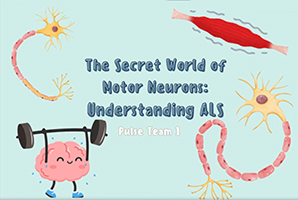 Our PULSE Assignment focuses on Amyotrophic Lateral Sclerosis (ALS), a progressive neurodegenerative disease that affects motor neurons and gradually weakens muscles, which affects walking, speaking, swallowing and eventually breathing. ALS can be complex and challenging to understand, especially for younger audiences; thus, our group decided to communicate information about the disease through a children’s storybook.
The storybook explains ALS in a simple, engaging, and age-appropriate way, using storytelling and visuals to help readers understand how the brain communicates with muscles and how this process is affected in ALS. By presenting scientific concepts in a narrative format, we aimed to make the topic easier to understand while remaining sensitive to individuals living with the disease.
Through this project, our goal is to increase awareness and understanding of ALS, particularly among younger audiences who may not otherwise be exposed to information about neurological diseases. By introducing the topic in a compassionate and accessible way, we hope the storybook encourages empathy and helps readers better understand the challenges faced by people living with ALS.
Overall, our project aims to create an educational and meaningful resource that makes learning about ALS approachable while fostering awareness and support for individuals affected by the disease.
Keywords: Amyotrophic Lateral Sclerosis, Neurodegeneration, Muscles, Morbidity
- PULSE Team Assignment - Team 1 (PDF, 235 KB)
Insights into Ischemic Stroke - Team 25
Media Type: Website
Summary
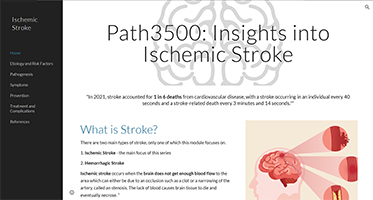 Ischemic stroke is a medical emergency where the brain does not receive enough blood flow, resulting in necrosis of the brain tissue. This condition can occur due to a clot blocking the blood or stenosis/narrowing of the vessel, causing ischemia. Stroke symptoms come in various ways depending on the artery that is occluded. This website aims to inform pathology students (or learners just interested in ischemic stroke in general) about this disease. This relatively common disease has plagued the lives of many, and it is crucial to both spread awareness and knowledge about its risks, symptoms, prognosis, and many other things.
We chose to use a website as our medium, as it offers an interactive experience for learners, and it allows students to pursue their interested topic at their own pace. Our website features an intuitive layout and provides proper introductions to each learning module, where we discuss a specific aspect of ischemic stroke. We also have review questions under each learning module to help learners test their understanding, further improving the effectiveness of our chosen approach. We hope that our chosen format can stay engaging for their audience throughout their time there.
Keywords: Ischemic Stroke, Cerebrovascular Occlusion, Blood Clot, Thromboembolism, Sensory Deficits, Cholesterol Management
- PULSE Team Assignment - Team 25 (PDF, 324 KB)
ALS Explorer - Team 28
Media Type: Website
Summary
 We chose to present our topic of Amyotrophic Lateral Sclerosis (ALS) by creating an interactive educational website called ALS Explorer to provide users with a better understanding of ALS and its effects on the body. The website includes general information on ALS, such as the etiology, pathogenesis, symptoms, epidemiology, and prognosis. Each section was written and formatted to make it as accessible and clear as possible, so that users can learn and retain the content more easily.
To help reinforce the information, we also included a ‘Games’ section where we have a crossword puzzle, jeopardy, quiz, and matching game for users to test their knowledge on the content they have learned. Additionally, we included a case study which features both a 3D model and a histological representation of ALS. We added this case study to challenge users as it requires them to apply their pathology and etiology knowledge to a clinical scenario. This is a good application of knowledge as it requires a deeper understanding and problem solving approach as compared to simply memorizing the information.
We chose ALS as our topic as it is part of the Diseases of the CNS unit, meaning we could reinforce the concepts, which are on Exam 4, while working on this project. We also chose to focus on ALS because it is a disease that affects many people and currently has no cure. Increasing awareness can help educate more people on the disease and its impact on patients. Although many people have heard about ALS through the Ice Bucket Challenge, many have not been taught about the disease or its effects on the body. By creating this website, we hope to make this information on ALS more accessible and deepen our user’s understanding of ALS in a meaningful and educational way.
Keywords: ALS, Neurodegenerative Disease, Genetic Mutations, Clinical Pathology, Motor Neurons
- PULSE Team Assignment - Team 28 (PDF, 478 KB)
Written In the Code: Exploring Huntington’s Disease - Team 36
Media Type: Learning Module
Summary
 Huntington’s disease is a genetic brain disease that slowly damages the brain over time, causing problems with movement, thinking, and behavior. Patients may experience common symptoms like jerky noncontrolled movements, trouble with walking and balancing, and trouble with speaking or swallowing. It's typical for symptoms to start in adulthood but in some cases, they can appear in youth too. In either case, they get worse as time goes on.
For our PULSE assignment, we created an educational interactive module to explain Huntington's disease to the general audience. Our goal with this project was to try to make complex medical information understandable and highlight that research on this disease is ongoing. We decided to focus on this disease specifically because of its progressive nature which can affect families and patients deeply. This format of learning aims to combine clear explanations regarding the disease with interactive visual components so that learners can retain information as they scroll through the module.
The module covers what Huntington's disease is, how genetics can play a role, how symptoms are usually managed, what scientists are exploring for future therapeutic options, how the brain is affected, and finally, the cause, mechanism, long-term effects, outcome and distribution are also described. The module is focused on helping the audience understand why this disease is important and how future research can help improve the lives of people with this disease. It emphasizes the challenges of Huntington's while making the content meaningful, interactive, and self-paced. This format allows users to explore concepts at their own speed, giving them time to understand more challenging ideas, while the interactive components help keep users engaged with the material.
Keywords: Trinucleotide Expansion, HTT Gene, Neurodegenerative Disease, Chorea, Huntingtin Protein, Autosomal Dominant Inheritance
- PULSE Team Assignment - Team 36 (PDF, 405 KB)
Puzzling Pathologies in 15 Minutes - Team 46
Media Type: Podcast
Summary
 My PULSE experiential assignment focuses on epilepsy and is presented as a podcast designed for students in grade 12 science or first year university who are interested in entering the medical field. These students usually have a basic understanding of neurons and action potentials, but are looking to build on that knowledge in a way that is still easy to follow. Western University, in affiliation with London Health Sciences Centre’s University Hospital, is home to one of the leading epilepsy units in North America, showing how relevant and actively studied this condition is.
I also chose epilepsy because it is more common than commonly thought, affecting about 1 percent of the global population. It is also something I have a personal connection with, as a family member of mine had epilepsy when I was younger. At the time, I only understood it at a basic level and did not have access to clear, engaging explanations of what was happening in the brain. That experience influenced me to create something that could help others in a similar position.
I chose a podcast format because it is accessible and popular among students. It allows listeners to explore topics at their own pace while still engaging with more detailed ideas. Since there are no visuals, I focused on explaining concepts clearly while keeping enough depth to make the content meaningful.
Even without a direct connection to epilepsy, listeners can still learn key concepts such as potassium efflux in action potentials and the roles of glutamate and GABA in brain signaling. Overall, this assignment helps bridge basic biology and more advanced medical understanding in an approachable way.
Keywords: Epilepsy, Seizures, Action Potentials, Brain Activity, Awareness
- PULSE Team Assignment - Team 46 (PDF, 201 KB)