

Diseases Central Nervous System 2025
Title of Volume: Neurology in Focus: Stiff Person Syndrome Uncovered - Team 19
Media Type: Magazine
Summary
 For our PULSE assignment we created an informative magazine covering Stiff Person Syndrome (SPS) for students interested in pathology. As SPS is a rare condition lying at the intersection between the Immune Disorders and CNS content covered in PATH 3500, we wanted to raise awareness about it. We chose to format it as a magazine because it allowed for writing comprehensive articles, while also adding engaging elements like puzzles and patient testimony - beyond the constraints of an infographic. We explore SPS by introducing readers to key background information about the condition, resulting from the production of autoantibodies against an inhibitory neurotransmitter called GABA, causing muscle stiffness. Delving into the symptoms and etiology, we discuss further the mechanism which SPS presents itself and predispositional risk factors. Using ChatGPT, we generated an interview with a fictional patient living with SPS to help readers understand first hand what it would be like to live with the diagnosis. As found in other magazines, we included some puzzles, a celebrity story and informative graphics for fun and to get the reader to reflect on what they learned. The project also explores the various clinical classifications, including partial SPS and Progressive Encephalomyelitis with Rigidity and Myoclonus. We conclude with diagnostic tests for SPS, current treatments, and novel therapies in development. By providing information in an engaging and digestible format, we aimed to make this complex disorder more accessible.
Keywords: Neurological Disorder, Autoimmune Disease, Stiff Person Syndrome (SPS), Patient Experience, Diagnosis and Treatment, Medical Research and Advances
- PULSE Team Assignment - Team 19 (PDF, 290 KB)
PATHOL 4014A: PathALS - Team 22
Media Type: Website
Summary
 Our PULSE assignment focuses on Amyotrophic Lateral Sclerosis (ALS), a neurodegenerative disease that progressively weakens muscles and impairs movement. We created an educational website in the form of an OWL site incorporating podcasts, videos, and simple articles to explain ALS in an accessible way for a general audience, as we wanted to make complex information easy to understand and engaging for those without a medical background. Using podcasts (“lectures”) and videos that visually explain how ALS impacts the body and available treatment options, we aim to increase the public’s understanding of this disease, as it is often misunderstood. Our goal is to raise awareness, support understanding, and foster empathy for those impacted. By providing this resource, we hope to inspire support for people with ALS as well as advocacy efforts, creating a space where people can learn, connect, and understand ALS in a meaningful way.
Keywords: Neuropathology, Amyotrophic Lateral Sclerosis, Clinical Pathology, Signs and Symptoms, Neurodegenerative Disease, Genetic mechanisms
- PULSE Team Assignment - Team 22 (PDF, 217 KB)
The Road to MS: Navigating the Path from Symptom to Diagnosis - Team 25
Media Type: Infographic
Summary
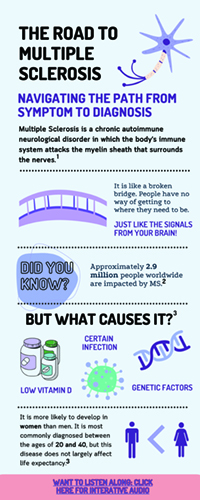 Multiple Sclerosis (MS) is an autoimmune disease in which an individual's immune system mistakenly attacks the protective covering of nerves, disrupting the signals in the body. This hinders how our body and brain communicate with each other. Often, this disease can lead to muscle weakness, difficulty walking, fatigue, and vision problems. MS is a lifelong condition, but its severity and progression vary from person to person.
Our project is an interactive infographic with an embedded supplementary podcast that helps learners explore the journey of MS. From investigating its causes and symptoms to its effects on mobility, future treatments and prognosis, our infographic provides a clear, visual way to understand how MS affects the body. Viewers can navigate through different sections to learn about diagnosis, types of MS, treatment options, and emerging research.
This format was chosen because visual learning can make complex medical topics more engaging and accessible. Furthermore, by making our infographic interactive with an embedded podcast, we were better able to drive home our message. The infographic simplifies scientific concepts. This allows the learner to obtain an immersive experience and grasp key ideas without overwhelming medical jargon. Through the use of simple terms and metaphors, the issues surrounding MS are simplified. This project is primarily designed for students, but it is able to explain the disease to anyone curious about MS.
MS research is rapidly evolving, and promising therapies offer hope for better disease management and improved quality of life. By creating this resource, we aim to raise awareness, encourage discussion, and help learners appreciate the importance of early diagnosis, treatment, and ongoing scientific discovery in MS care.
Keywords: Multiple sclerosis, Neurologic disorder, Autoimmune disorder, Neurodegeneration, Immunosuppressants, Remyelination
- PULSE Team Assignment - Team 25 (PDF, 208 KB)
Navigating Alzheimer’s Disease: A Module For You and Your Family - Team 27
Media Type: Learning Module
Summary
 Alzheimer’s Disease (AD) is a progressive brain disorder that affects memory, cognition, and behaviour. Earlier stages of the disease typically involve mild memory loss. However, as the disease progresses, symptoms become more severe, impacting everyday tasks and relationships with loved ones. While the main hypothesis behind the onset of Alzheimer’s involved the buildup of amyloid plaques, a newer and lesser known theory revolves around neuroinflammation. These evolving theories showcase the complexity of AD, highlighting the continuous need for further research to help understand this disease better.
This project is an online learning module (OLM) on AD and explores the epidemiology, complications, etiology, pathogenesis, and prognosis associated with this disease. We end the OLM with some helpful tips for managing AD. This module uses simplified explanations, visual aids, and audio to help learners further understand this complex disease.
We chose this topic because Alzheimer’s affects millions of families, and it can be a scary and confusing condition to navigate. This module was created to help individuals, especially those with loved ones who have been diagnosed, gain a clearer understanding of this disease. By presenting our information in an accessible and interactive format, learners are engaged with various resources to deepen their understanding and knowledge of the disease.
Our goal with this OLM is to simplify the scientific aspects of AD, providing families and students with not only a simplified way to understand the disease, but also a practical way to support their loved ones, their community, and themselves through the many challenges that come with AD.
Keywords: Alzheimer’s Disease, Neuroinflammation, Dementia, Amyloid-beta plaques, Cognitive
impairment, Neurodegeneration
- PULSE Team Assignment - Team 27 (PDF, 190 KB)
Behind the Sheath: Shining a Spotlight on Multiple Sclerosis - Team 32
Media Type: Magazine
Summary
 Our assignment explores Multiple Sclerosis (MS), a chronic autoimmune disease of the central nervous system (CNS) where the immune system mistakenly attacks the myelin sheath, disrupting nerve signal transmission. The pathogenesis of MS involves genetic predispositions and environmental triggers including Epstein-Barr Virus (EBV), vitamin deficiencies, and smoking. These factors contribute to immune cell over-activation, leading to inflammation, demyelination, and eventually neuronal dysfunction.
MS presents in different clinical forms: clinically isolated syndrome (CIS), relapsing-remitting MS (RRMS), secondary progressive MS (SPMS), and primary progressive MS (PPMS). Symptoms vary from visual disturbances and fatigue to mobility issues to cognitive impairments. Diagnosis often involves MRI scans and biomarkers like oligoclonal bands and neurofilament light chain (NfL).
The prognosis of MS depends on several factors such as age of onset, symptom type, lesion location, sex, and disease subtype. While some individuals experience mild symptoms and long periods of remission, others face rapid progression and disability. Biomarkers, lesion burden, and tools like the Expanded Disability Status Scale (EDSS) help monitor disease progression.
Treatment focuses on immunosuppressive and disease-modifying therapies (DMTs) including ocrelizumab, fingolimod, teriflunomide, and alemtuzumab. However, these treatments carry risks of opportunistic infections such as tuberculosis, herpes viruses, and hepatitis B. Nutritional strategies and lifestyle modifications are also emphasized to support long-term wellness.
Our magazine-style project, Behind the Sheath, aims to present complex scientific content in a visually engaging and accessible way. It includes detailed information on MS etiology, pathogenesis, symptoms, risk factors, treatments, prognosis, and patient perspectives. Paired with interactive activities and special features, like a Celebrity Spotlight, we hope readers find out content engaging and that this resource fosters
awareness, empathy, and a better understanding of MS.
Keywords: Neuropathology, Amyotrophic Lateral Sclerosis, Clinical Pathology, Signs and Symptoms, Neurodegenerative Disease, Genetic mechanisms
- PULSE Team Assignment - Team 32 (PDF, 580 KB)