

Neoplasia 2026
A look at Retinoblastoma - Team 14
Media Type: Infographic
Summary
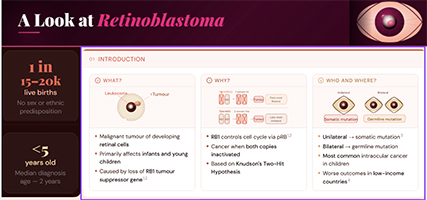 Our PULSE experiential assignment is about retinoblastoma, which is a rare eye cancer that mostly affects babies and very young children. We chose this topic because it connects well to what we learned in class about how cancer begins and grows. It is also a topic that feels important in real life, because catching it early can make a huge difference for a child’s health, vision, and chance of survival.
We decided to present our project as an infographic poster. We chose this format because it is easier for people to read and understand than a long paper full of hard words. A poster lets us organize the information into clear sections, use visuals, and highlight the most important points in a way that feels quick, engaging, and accessible. We wanted to make sure someone without a science background could still learn from it and come away from understanding why this disease matters. Our poster explains what retinoblastoma is, who it affects, and why it is different from many other cancers. It also looks at the causes of the disease, how it can affect one or both eyes, what warning signs people should look for, and how doctors find and treat it. We included information about common signs such as a white glow in the eye, crossed eyes, and vision problems, as well as the importance of family history and early testing in some cases. The poster also covers treatment options and the balance between saving the child’s life and protecting vision whenever possible. We chose this topic and format because we wanted to take something serious and complex and turn it into something clear, useful, and meaningful for a broader audience. Overall, our goal is to help people better understand this childhood cancer and why early attention and care are so important.
Keywords: Retinoblastoma, RB1 Gene, Two-Hit Hypothesis, Leukocoria, Pediatric Cancer, Early Detection
- PULSE Team Assignment - Team 14 (PDF, 433 KB)
Adaptations in Cancer Cells - Team 18
Media Type: Interactive Infographic
Summary
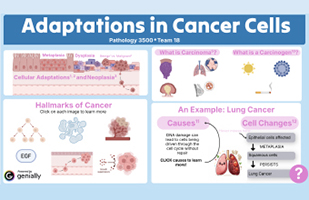 Cellular adaptations are ways that our body’s cells respond to stress or harmful conditions. While these changes can initially be a protection mechanism for the body, if the stress is persistent they sometimes can lead to pathological issues. For example, a process called metaplasia can occur when one cell type changes to another that is better suited to handle the stress. For a short period of time this is normal but if the stress continues these cells can acquire abnormal features that can cause them to divide and grow uncontrollably. This can eventually lead to cancer.
This topic was chosen as it is a very relevant issue in the population and it provides some insight as to how cancer develops at the cellular level. This can help to raise awareness about prevention and avoiding the common risk factors.
Our assignment is presented as an interactive infographic that explains all the relevant information related to cellular changes, progression of cancer, and an example of cancer that connects these ideas. This format was chosen as it gives a clear, visual, and easy-to-understand way to communicate the information. After working through all interactive aspects of the infographic to learn all the details of this topic, there are practice questions to help reinforce understanding after learning the material.
Keywords: Metaplasia, Dysplasia, Carcinoma, Neoplasia, Carcinogen
- PULSE Team Assignment - Team 18 (PDF, 268 KB)
Inside Glioblastoma: How the Most Aggressive Brain Tumor Develops Spreads and Gets Treated - Team 24
Media Type: Website
Summary
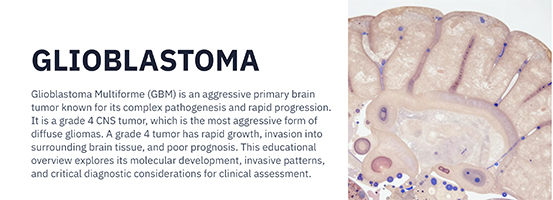 The assignment was based on the pathology and treatment of glioblastoma. We explained the disease from how it begins, how it grows and spreads, how it is treated and the outcome of the cancer. Glioblastoma is the most aggressive and deadly type of brain tumor. It rapidly develops and then it spreads into the surrounding brain tissue making it extremely difficult to treat. Our specific assignment presents glioblastoma through an educational website. The website places emphasis on why Glioblastoma has such a poor prognosis despite modern medical advances.
Keywords: Glioblastoma, Tumor Suppressors, Mutations, Cancer, Pathogenesis, Imaging
- PULSE Team Assignment - Team 24 (PDF, 282 KB)
A Neoplasia Field Trip - Team 26
Media Type: Comic Book
Summary
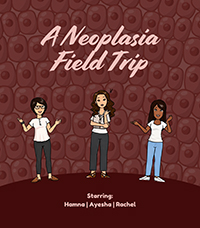 When we hear the word “cancer,” we are usually referring to a condition that begins with neoplasia—the abnormal and uncontrolled growth of cells. Some of these growths are harmless, but others become malignant, meaning they can spread and damage other parts of the body.
Our project focuses on one of the most common cancers in men: prostate cancer. The prostate is a small gland in the male reproductive system, and as men age—especially after 50—the risk of developing cancer in this gland increases. Prostate cancer often grows slowly and may not cause any noticeable symptoms at first. This is why regular screening, such as PSA (prostate-specific antigen) blood tests and digital rectal exams (DRE), plays a key role in early detection.
We chose a blog format to present our content in a conversational, accessible way. In our blog, we explain how prostate cancer develops, the role of hormones like testosterone in its progression, and what treatment options are available depending on the stage of the disease.
We also include a realistic, fictional case study to show how prostate cancer might be discovered and treated in real life. This case was generated using ChatGPT and then reviewed and edited by our team to ensure scientific accuracy.
By using a blog format, we aimed to make complex scientific information understandable for a wide audience. Our goal is to raise awareness about prostate cancer and emphasize the importance of early screening and informed decision-making.
Keywords: Neoplasia, Benign and Malignant Tumors, Tumor Growth and Metastasis, Cellular Proliferation, Teratoma, Cancer Diagnosis and Treatment
- PULSE Team Assignment - Team 26 (PDF, 327 KB)
GRWM to Become Cancerous (Hallmark by Hallmark) - Team 33
Media Type: Video
Summary
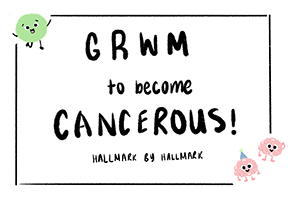 Our PULSE experiential assignment explores the development of cancer using the Hallmarks of Cancer framework, which outlines the key biological changes cells acquire during malignant transformation. We chose to present this content in the form of a short, influencer-style vlog video inspired by “Get Ready With Me” (GRWM) social media content. In the video, a normal cell is personified as an influencer going through a “day in the life”, where it slowly breaks biological “rules” that normally regulate cell growth and behaviour. We utilized relatable, pop-culture style metaphors and analogies that connect pathology concepts to familiar online experiences to both engage the audience, and hopefully allow the ideas to be easier to integrate into memory. This format was chosen to make complex cancer biology accessible to a lay audience, including high-school level learners, or individuals without an extensive science background. By translating technical terminology into everyday language and visual storytelling, the video can help learners understand the step-by-step process by which cancer arises. Overall, this assignment aims to improve scientific literacy by presenting core pathology concepts in an engaging, memorable and approachable way.
Keywords: Neoplasia, Hallmarks of Cancer, Tumour Biology
- PULSE Team Assignment - Team 33 (PDF, 260 KB)