Curriculum

bne curriculum

On this page

Curriculum overview

Our four-year medical curriculum integrates early clinical exposure, and hands-on simulation to build strong clinical and diagnostic skills.


Learn more

Curriculum by year

Learn how we’re transforming our curriculum with a competency-based, patient-informed model designed for today’s complex health care landscape.


Learn more

Patient-centred approach

Discover how a patient-centered approach shapes our entire curriculum, and encourages a deep understanding of the communities we serve.

Learn more

Curriculum overview

Our renewed undergraduate medical curriculum embraces a competency-based, active learning approach that supports adaptive, collaborative learning and reflects the evolving needs of care in our communities.


For more information and course descriptions please click on the index buttons above or continue scrolling down this page.

Four year course track:
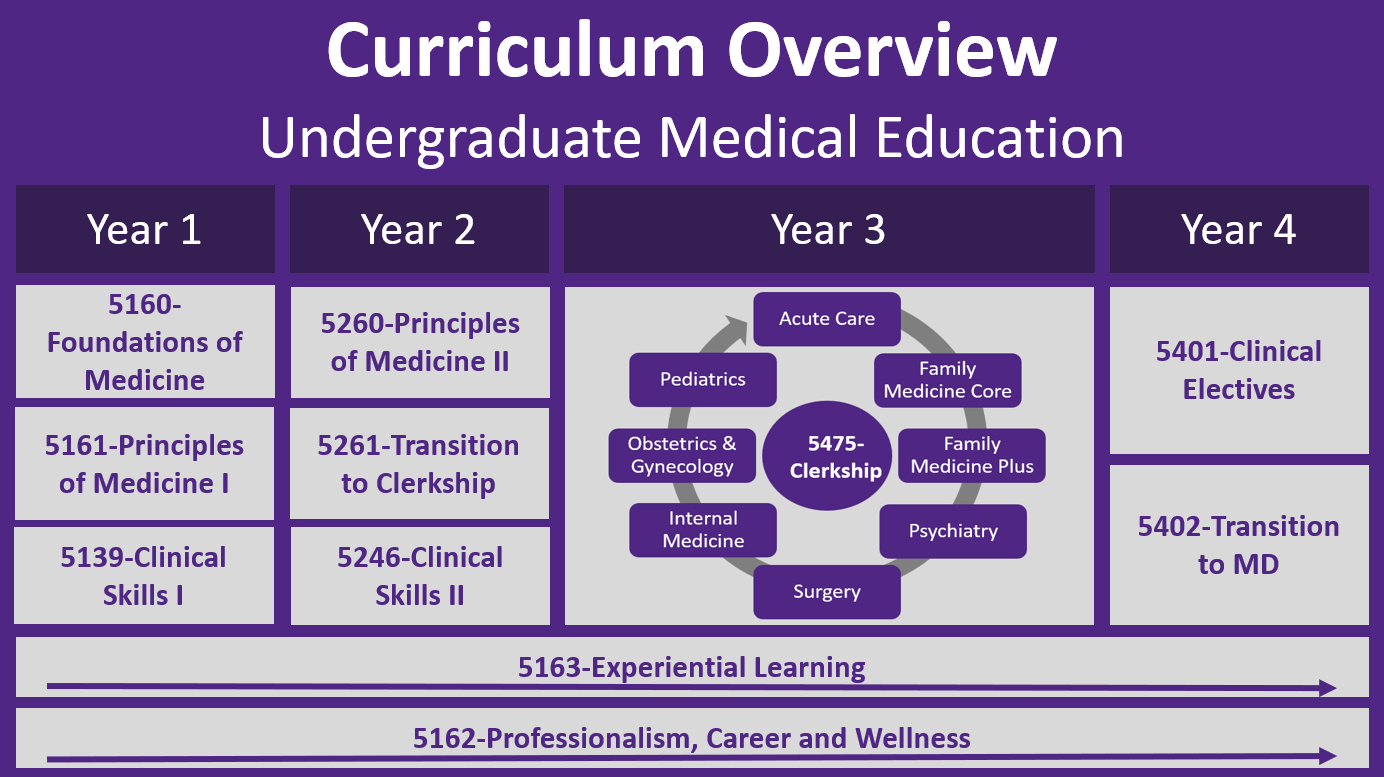
UME curriculum overview

Curriculum by year

Our four-year MD program provides students with the knowledge, skills and attitudes to advance to graduate or post-graduate studies, leading to clinical practice, research or other medical careers.

Year one

From your first year, you’ ll gain early patient experience through Clinical Methods, where you’ll begin to develop a patient-centred approach to care. At the end of Year 1, you’ll take part in Rural & Regional Discovery Week, working in a hospital or clinic in a Southwestern Ontario community to gain hands-on clinical experience and a deeper understanding of the communities where patients live.

A course taking place from September to the end of December will support and assess learner competence on key topics in the foundational and specific clinical sciences necessary for critical thinking, problem-solving, and clinical decision-making. A key goal is outlined in the first week – “How to think like a physician”.

The curriculum will incorporate the social determinants of health, ethics, cultural competence, health promotion and prevention. This and all subsequent courses will be aligned with issues prominent in Canadian health care, especially those applicable to Southwestern Ontario.

An introduction to Hematology, Infectious Diseases, Immunology and Microbiology will offer clinical application for learning. This course will instill a firm grounding in what will be Themes within courses of: Basics of Anatomy and Cell Biology; Pathology and disease; Laboratory Medicine, Imaging, Lab and Pathology Diagnostics and Choosing Wisely; basic Pharmacology and therapeutics; Physiology; Ethics; Diversity and ethnic challenges; Health Systems; Quality Management; Biochemistry; Genetics (including genomics, epigenetics) and Evidence Based Care.

Learning will use a variety of methods including case-based and small group/team-based learning, interactive large group learning, labs and independent learning. This course will serve as a secure grounding for learning in other parallel and subsequent Program courses. Students will be introduced to the grounding for EPAs in demonstrating the tasks of a physician.

Each course, ( January 2 to mid-June of year 1 for Principles of Medicine I and September 2 to end January for Principles II), will support student development of competence in the key principles of body system or medical discipline based learning drawn from existing courses in the present curriculum with first and second year. Integration of content objectives will occur across the course using a case-based and application model of active learning at the end of course, and with parallel (Clinical Skills) and subsequent courses (Transition to Clerkship and Clerkship). Curricular competencies learned and assessed in these courses extend beyond medical expert to include all curricular competencies. Course goals are to integrate foundational and clinical sciences with learning related to social determinants of health and social accountability, while establishing competence to enter clerkship where they will have an active role in patient care and management. Case-based learning will serve as an environment for key integration, clinical reasoning and competency assessment. Students will see their growth as a clinician in their maturation of effectiveness in the Entrustable Professional Activities.
This course examines the process of the doctor-patient interaction. Using a patient-centred approach, instruction is given in interviewing and physical examination. Clinical reasoning and decision making are explored through the Problem-Orientated Clinical Record. Professionalism and ethics are emphasized as they relate to the clinical setting. Integration of knowledge, application of skills and development of appropriate attitudes are evaluated in this course. Students begin to develop history taking and physical exam skills. 
An important area of medical education is supporting the development of professional identity in students. This requires more than lectures, and is better understood in small group and seminar/team-based learning approaches. This course will introduce and reinforce key approaches to topics such as: professional regulation/ethics/boundaries; personal finance; career success tools; leadership and working in teams; reflection and professional improvement and personal wellness. This course will span all four years.
A core strategy of Western University’s strategic plan is to expand student access to and assessment in learning that derives from involvement in future work place projects. This course will oversee student achievement in the new Longitudinal Clinical Experience and established team based projects such as Service Learning and the Patient Safety/ Quality Improvement project. Because understanding and researching evidence and contributing to the expanded community of learning in health care will be a key competency in our student’s future, this course will also contain a module of original research developed with a mentor and delivered in teams of up to 4.

Year two

Each course, (January 2 to mid-June of year 1 for Principles of Medicine I and September 2 to end January for Principles II), will support student development of competence in the key principles of body system or medical discipline based learning drawn from existing courses in the present curriculum with first and second year. Integration of content objectives will occur across the course using a case-based and application model of active learning at the end of course, and with parallel (Clinical Skills) and subsequent courses (Transition to Clerkship and Clerkship). Curricular competencies learned and assessed in these courses extend beyond medical expert to include all curricular competencies. Course goals are to integrate foundational and clinical sciences with learning related to social determinants of health and social accountability, while establishing competence to enter clerkship where they will have an active role in patient care and management. Case-based learning will serve as an environment for key integration, clinical reasoning and competency assessment. Students will see their growth as a clinician in their maturation of effectiveness in the Entrustable Professional Activities.
Transition to Clerkship builds on content learned during Year 1 Foundation courses, Principles of Medicine 1 & 2 and Clinical Skills. It will prepare students for the practical skills and the clinical reasoning that are further developed during Clerkship. The focus will be on the transition from classroom-based learning to the workplace learning of clinical training. Students need to consolidate the knowledge they have learned from previous courses and begin the daily "thinking" and problem solving that physicians do, in the clinical environment. The course offers an introduction to the routins, and the culture of the workplace, as well as to expose their role and the expectations as part of the health care team. Learning outcomes and activities have been based on a framework of workplace learning which includes: (1) Preparation to participate in authentic tasks and activities of a physician; (2) Familiarization with relationships in clinical settings; (3) Introduction of Work Practices. 
This course examines the process of the doctor-patient interaction. Using a patient-centred approach instruction is given in interviewing and physical examination. Clinical reasoning and decision making is explored through the Problem-Orientated Clinical Record. Professionalism and ethics are emphasized as they relate to the clinical setting. Integration of knowledge, application of skills and development of appropriate attitudes are evaluated in this course. Students continue to refine history and physical exam skills with a focus on the life cycle and discipline specific content.
An important area of medical education is supporting the development of professional identity in students. This requires more than lectures, and is better understood in small group and seminar/team-based learning approaches. This course will introduce and reinforce key approaches to topics such as: professional regulation/ethics/boundaries; personal finance; career success tools; leadership and working in teams; reflection and professional improvement and personal wellness. This course will span all four years.
A core strategy of Western University’s strategic plan is to expand student access to and assessment in learning that derives from involvement in future work place projects. This course will oversee student achievement in the new Longitudinal Clinical Experience and established team based projects such as Service Learning and the Patient Safety/ Quality Improvement project. Because understanding and researching evidence and contributing to the expanded community of learning in health care will be a key competency in our student’s future, this course will also contain a module of original research developed with a mentor and delivered in teams of up to 4 students.
Each week begins with a new case that anchors your learning and connects key objectives of the MD program. You’ll explore concepts through small-group tutorials, problem-based learning, lectures, labs, and self-directed study—all designed to help you integrate knowledge and apply it in real-world contexts. Dedicated time is also built in for you to explore career paths and professional interests.

Year three

The third year of medicine includes a 52-week integrated Clerkship (Medicine 5475)

The Clinical Clerkship Program at Western’s Schulich School of Medicine & Dentistry is an integrated 52-week course in the third year of the four-year MD program which is distributed across various sites in Southwestern Ontario.  During Clerkship, the student becomes an active member of clinical care teams in the following medical disciplines: family medicine, medicine, obstetrics and gynaecology, paediatrics, psychiatry, emergency medicine, anesthesia, and surgery. Under the supervision of faculty and more senior housestaff, clerks are given graded responsibility in the diagnosis, investigation, and management of patients in hospital, clinic and outpatient settings.  All students in third year are required to complete a community/rural Clinical Clerkship rotation for a minimum of four weeks.

The Clinical Clerkship Program in London is being delivered at the Medical Sciences Building and the Dental Sciences Building at Western University, at the London Health Sciences Centre and St. Joseph's Health Care and at other regional education sites through the Distributed Medical Education.

The Clinical Clerkship Program in Windsor is being delivered at the Medical Education Building on the campus of the University of Windsor, at Windsor Regional Hospital, Hôtel-Dieu Grace Hospital and at other regional education sites through the Distributed Medical Education. 

The Schulich School of Medicine & Dentistry's Sarnia clerkship program is an immersive, community-based clinical training experience for third-year medical students, established in partnership with Bluewater Health and the Rapids Family Health Team. Students in this new program complete most of their required clerkship rotations in the Sarnia-Lambton area to foster deeper connections and provide a more comprehensive understanding of regional healthcare needs. The program, which began in 2025, includes rotations in various disciplines like family medicine, surgery, obstetrics and gynecology, internal medicince, anesthesia, and emergency medicine. Pediatric rotations are completed at the students' home campus. 

Distributed Medical Education includes faculty located in over 45 communities in the region from Tobermory to Leamington.  Students learn clinical skills in various geographic sites.  The objective is to ensure that Western students at all levels gain an understanding and experience of the practice of Medicine from both a rural/regional and tertiary care/urban perspective.

An important area of medical education is supporting the development of professional identity in students. This requires more than lectures, and is better understood in small group and seminar/team-based learning approaches. This course will introduce and reinforce key approaches to topics such as: professional regulation/ethics/boundaries; personal finance; career success tools; leadership and working in teams; reflection and professional improvement and personal wellness. This course will span all four years.

Year four

Beginning in Year 4, Clinical Electives are arranged entirely by the student in any area of medicine, at Schulich Medicine & Dentistry or in other centres. After completion of the Clinical Electives, students return to campus in January for Transition to MD which permits students to further integrate the basic and clinical aspects synthesized with their clinical experience. For more information on 'What You Need to Know' about Year 4 Clinical Electives (including Applying for Electives, Academic/Clinical Policies & Procedures, Assessment and General Information), please click on the link below.

Transition to MD advances student competency beyond Clerkship and is foundational for entering supervised practice. The course supports a learning environment of professional practice to advance Year Four students as mature learners who must be able to function in a learning environment that is grounded in independent learning; small group; collaborative and with some large group interactive non-didactic sessions based on clinical presentations not diseases. The course supports students meeting the Entrustable Professional Acts of the Medical Council of Canada. The course provides students with an approach to common societal problems by integrating advances in Basic Sciences, appropriate use of investigation, evidence based critical appraisal, use of therapeutics including medication, education, counseling and prevention and collaboration with other Health Care Professionals into demonstrating competency in supervised practice. The course provides professional and life skills for entering residency. The course allows for a clinical patient care experience with an independent self or team-based project to answer a question or issue of a chronic disease of interest to the learner.

An important area of medical education is supporting the development of professional identity in students. This requires more than lectures, and is better understood in small group and seminar/team-based learning approaches. This course will introduce and reinforce key approaches to topics such as: professional regulation/ethics/boundaries; personal finance; career success tools; leadership and working in teams; reflection and professional improvement and personal wellness. This course will span all four years.

Patient-centred approach

Learn through a patient-centred curriculum that emphasizes compassion, presence, and a commitment to supporting patients, their families, and communities. Develop the skills to build meaningful relationships with patients, understand their perspectives, and work collaboratively to find shared approaches to care within a broader social and environmental context.

Build a strong foundation in the biological, behavioural, and population sciences, and apply your knowledge in the context of patients’ lives while developing the insight needed to understand their experiences of illness.

Continue the tradition of lifelong learning and discovery shared by all Western MD graduates.