

Immune and Immune Disorders 2026
Fix the Body! A Sarcoidosis Case Study - Team 6
Media Type: Interactive Game
Summary
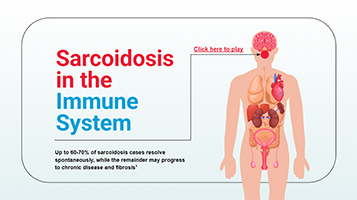 Our PULSE experiential assignment is an interactive slideshow game that follows a case study to explore the various connections between sarcoidosis and course content. Instead of a traditional paper or presentation, the diagnosis game challenges users to work through a patient case step-by-step, making decisions and actively learning throughout the process. The user can click on different levels to deepen their understanding of each system, and go back and forth when selecting “Test Your Knowledge” answers.
The game follows a 34-year-old woman who presents with initial symptoms such as fatigue, cough, and shortness of breath. User moves through four levels, representing different body systems: 1) Immune Disorders, 2) Respiratory System, 3) Nutritional and Metabolic Diseases, and 4) Hepatobiliary Diseases. At each stage, they learn background information and apply the knowledge to diagnose the patient.
We picked sarcoidosis as our topic, a complex inflammatory disease that can affect multiple organs in the body, because it connects to four lecture systems we have explored in Pathology 3500. Sarcoidosis has a wide range of symptoms and an unclear cause, making it a great example of how diseases can affect the whole body. Since the target audience is people with a high school level of scientific understanding, this game format makes learning more engaging and accessible. By turning complex pathology concepts into interactive questions and real-life scenarios, the assignment helps users actively learn rather than passively read.
On a broader scale, the impact of this project focuses on health education. Our goal is to simplify complicated medical concepts for clearer scientific communication among the general population. This approach improves public awareness of chronic diseases and makes science more approachable.
Keywords: Immune Disorders, Respiratory System, Nutritional and Metabolic Diseases, Hepatobiliary Diseases, Diagnostic Tools, Interactive Learning
- PULSE Team Assignment - Team 6 (PDF, 309 KB)
T Cell Life - Team 9
Media Type: Interactive Game
Summary
 T-lymphocytes are components of adaptive immunity that allow for stronger immune responses and immunological memory. Knowing the life cycle of T cells is essential because these stages determine how the immune system recognizes threats, mounts effective responses, forms immune memory, and develops diseases when regulation fails. T-lymphocytes that have not previously encountered an antigen (a foreign substance that triggers an immune response) differentiate into specialized functional types after the antigen is presented to them. A T-cell can bind directly to antigens and then mature into having supportive or toxic effects.
To accurately represent these various pathways, our experimental assignment explores the T cell’s life cycle, functions, and pathological states within immunity and immune disorders in the form of a “choose your own adventure” video game. This format is chosen to give players a clear chronological sequence of key events during T cell life cycles in a way that is interactive, engaging, and clear. Using both graphics and text to deliver information reflects different learning styles, and the addition of practice questions (presented as “What Would You Do” scenarios (WWYD)) helps students apply their knowledge through active recall.
Keywords: Lymphocyte, T-Cell, Cell Differentiation, Immune System, Autoimmune
- PULSE Team Assignment - Team 9 (PDF, 258 KB)
Inside SLE: A Journey Through Systemic Autoimmunity - Team 10
Media Type: Infographic
Summary
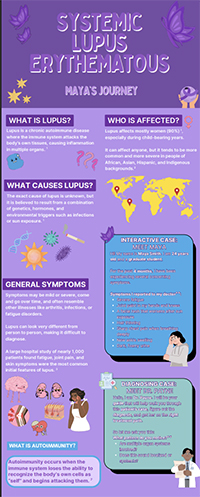 Our PULSE assignment focuses on Systemic Lupus Erythematosus (SLE), commonly known as lupus. Lupus is an autoimmune disease, which means the immune system - normally responsible for protecting the body - starts attacking healthy tissues instead. Because lupus can affect many organs, including the skin, joints, blood, and kidneys, it is often confusing for new learners to understand.
To make this complex topic easier to learn, our team created a visual infographic that presents the key features of lupus in a clear and simplified format. The infographic explains what lupus is, who is most affected, common signs and symptoms, and how doctors test for it. It also highlights possible complications and why early recognition matters. Our goal was to give future students an approachable, “big picture” overview before they study the disease in more detail.
We chose an infographic because visual tools help learners quickly understand relationships between symptoms, lab tests, and underlying immune system changes. Many undergraduate students benefit from information that is organized, easy to scan, and broken down into manageable pieces. This format also makes the topic more accessible to people outside of medicine, including high-school level learners or anyone curious about autoimmune diseases.
By creating a student-designed, evidence-based visual guide, our project aims to support clearer understanding of lupus and improve learning for future students studying pathology.
Keywords: Autoimmunity, Immunopathology, Inflammation, Systemic Disease
- PULSE Team Assignment - Team 10 (PDF, 240 KB)
Systemic Lupus Erythematosus - Team 34
Media Type: Infographic
Summary
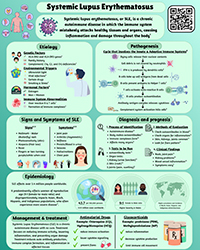 Systemic Lupus Erythematosus (SLE) is a chronic autoimmune disease. The immune system mistakenly attacks the body’s own tissues. This leads to ongoing inflammation. It can also cause damage in multiple organs. These include the skin, joints, kidneys, and blood vessels. Because SLE can affect many parts of the body, symptoms vary widely. This makes the disease difficult to diagnose. It is also challenging to manage. This is an unpredictable and complex condition.But from the studying of SLE, we may obtain important insight on its impact on overall health.
This infographic was designed to provide a clear and visual overview of SLE. It includes causes, disease mechanisms, symptoms, diagnosis, and treatment options. The goal was to simplify complex medical concepts. The content is organized into clear sections. This makes it easier to understand for people without a strong science background. Visual presentation helps readers quickly identify key ideas. It also shows how different parts of the disease are connected.
We chose this topic because, as medical students, we are interested in complex disorders. SLE involves both immune system dysfunction and multi-organ effects. Small changes in the immune system can lead to widespread damage. This makes the disease important to study. The infographic format was selected to improve both engagement and understanding. It is especially helpful for learners who find text-heavy materials difficult.
Overall, this project aims to increase awareness of SLE. It helps learners understand its complexity. It also shows its clinical impact. This is important for both patient care and medical education.
Keywords: Lupus, Autoimmunity, Systemic Disease, Inflammation
- PULSE Team Assignment - Team 34 (PDF, 245 KB)
Systemic Lupus Erythematosus: An Immune System's Mutiny - Team 35
Media Type: Interactive Infographic
Summary
 Our PULSE assignment is about Systemic Lupus Erythematosus (SLE), or lupus, which is an autoimmune disease where the immune system starts attacking the body’s own healthy tissues instead of protecting them. Because of this, lupus can affect many different organs and systems in the body, including the skin, joints, kidneys, lungs, heart, and brain. It can also look very different from person to person, which is part of what makes it hard to understand and sometimes difficult to diagnose. We chose this topic because lupus is a condition that many people have heard of, but may not actually know much about. We wanted to make it easier to understand by breaking down what it is, what can trigger it, how it affects the body, and how it is treated. Since it is such a broad and complex disease, we felt it was important to present the information in a way that would be easier for a general audience to follow. We chose to use an interactive infographic as our project's format because it allowed us to organize the extensive SLE information into short sections, combining video, images, audio, and written explanations. This helped make the assignment more captivating and accessible compared to a long and text-heavy explanation. Our project covers the causes and risk factors of lupus, its signs and symptoms, how it is diagnosed, and the treatments used to help manage it. Overall, the goal of our assignment was to make this complicated autoimmune disease more understandable while remaining informative and useful for people without a strong science background.
Keywords: Systemic Lupus Erythematosus, Autoimmune Disease, Infographic
- PULSE Team Assignment - Team 35 (PDF, 328 KB)