

Metabolic and Nutritional Diseases 2026
Vital Pulse: Your Daily Guide to Type-II Diabetes A-Z - Team 15
Media Type: Magazine
Summary
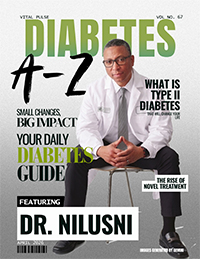 Type 2 Diabetes Mellitus (T2DM) is one of the most prevalent chronic diseases worldwide, affecting millions of people, and ranking among the leading causes of death in North America. It occurs when the body's cells stop responding to insulin, causing glucose to accumulate in the blood and silently damage the heart, kidneys, eyes, and nerves over time. Without proper management, T2DM can lead to life altering complications. Although there is currently no cure for T2DM, a range of treatments exist to help manage the condition, including lifestyle changes, medications and insulin therapy.
This project is presented as an interactive magazine, Vital Pulse, designed to educate pre-medical students and the general public about T2DM. The magazine covers pathogenesis and etiology of T2DM at cellular level, as well as its prognosis, complications, and treatment options. Readers can engage with an AI-assisted interview with a fictional diabetes specialist, Dr. Nilusni, who explains the biology of the disease in accessible, everyday language. The magazine also features interactive
activities including a crossword puzzle, word search, manga, and pop quiz to reinforce their understanding. The magazine format was chosen because it allows high-yield medical content to be presented in digestible, visually rich sections that accommodates a range of learning styles. With T2DM placing a growing burden on healthcare systems across Canada and worldwide, accessible and accurate public education about the disease is more important than ever. This project was developed as a supplemental learning resource for the Pathology 3500 course.
Keywords: Type-II Diabetes, Insulin, Hyperglycemia, Pancreas, Blood Sugar, Diabetes
- PULSE Team Assignment - Team 15 (PDF, 0 KB)
Storage, Stress, & Systemic Damage: Understanding Lysosomal Storage Disease - Team 16
Media Type: Website
Summary
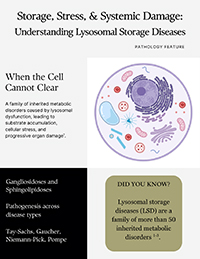 Our PULSE assignment focuses on lysosomal storage diseases, a group of rare inherited conditions where the body cannot properly break down certain substances inside cells. As a result, these materials build up over time and damage organs, especially the brain.
The assignment is presented as an editorial magazine, that has interactive quizzes, that guides users through multiple diseases, including Tay-Sachs disease, GM1 gangliosidosis, Gaucher disease, and Niemann-Pick disease. It explains how these conditions develop, what symptoms patients experience, and how they are currently managed. The format was chosen because these diseases are complex and often difficult to understand through text alone, so visual elements and simplified explanations help make the information more accessible to a general audience.
We chose this topic because lysosomal storage diseases, although rare, are severe and often life-threatening, especially in children. They are also commonly misunderstood, as many people are unaware that these conditions share a similar underlying cause—problems with the cell’s “recycling system.” Understanding this shared mechanism helps explain why different diseases can have similar symptoms, such as neurological decline and organ damage.
This project is important because it raises awareness of these disorders and highlights the need for early diagnosis and ongoing research. While treatments like enzyme replacement therapy exist for some conditions, many still have no cure. By presenting this information in a clear and engaging way, our assignment helps non-scientific audiences better understand these diseases, their impact on patients and families, and why continued medical research is essential.
Keywords: Lysosome, Metabolism, Genetics, Substrate Accumulation, Disorder
- PULSE Team Assignment - Team 16 (PDF, 345 KB)
PATH POWER: The Vitamin Vault - Team 45
Media Type: Magazine
Summary
 This assignment explores the essential roles and functions of vitamins learned throughout Path 3500, in the format of a song/music video. We chose this topic as it presents valuable and intriguing knowledge in a memorable and engaging method.
We created two songs, one dedicated to fat soluble vitamins and the other concerning water-soluble vitamins. The first song focuses on vitamins A, D, E and K with their roles, food sources along with pathological outcomes. For example, osteomalacia and rickets are both referred to in the verse about Vitamin D. Both pathological outcomes are characterized by a deficiency in Vitamin D causing inadequate bone mineralization. However, rickets predominantly affects children whereas osteomalacia is more common in adults.
The second song delves into the functions, food sources, and pathologies of vitamins C, B9 and B12 with terms including megaloblastic anemia, neural tube defects, myelin and pernicious anemia. Megaloblastic anemia can be defined as a deficiency in vitamin B12, leading to enlarged and deficient RBC. Vitamin B12 can be found in myelin, which forms insulated fatty layers around nerve cells. Pernicious anemia is an autoimmune disorder disrupting the absorption of vitamin B12. Neural tube defects are caused by insufficient vitamin B9 and lead to insufficient closing of the neural tube throughout development.
Overall, with a lay audience in mind, we attempted to create the songs without the use of complicated terminology. These songs serve as great memory aids in distinguishing the role of each vitamin, understanding their pathologies and food sources and differentiating between water and fat-soluble vitamins. With a visual aid and lyrics provided in the videos, students can associate colours, words and pictures with that vitamin. Our comprehensive goal is to equip students with an alternative, fun source to learn about the vitamins that play a key role in our day-to-day lives.
Keywords: Nutritional Diseases, Deficiencies, Fat-soluble vitamins, Water-soluble vitamins, Micronutrients, Magazine
- PULSE Team Assignment - Team 45 (PDF, 265 KB)


