

Hemodynamic Disorders, Thromboembolism and Shock 2026
Trumpeting news on elephantiasis and edema: How Lymphatic Obstruction Creates Elephant-Sized Limbs - Team 11
Media Type: Magazine
Summary
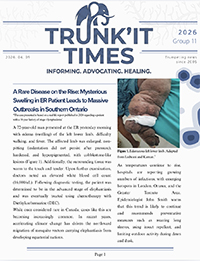 Elephantiasis (lymphatic filariasis) is an infectious disease caused by parasitic worms that are transmitted through mosquito bites. These parasites cause blockages in the
lymphatic system, which normally helps maintain fluid balance and supports immune function. As a result, fluid builds up in the tissues, leading to thickening of the skin and tissues, swelling (lymphedema), and local inflammation. Although elephantiasis has a low mortality rate, it is second most prevalent vector-borne disease and can have significant physical and social consequences. Many individuals affected by the disease face social stigma and discrimination, which can discourage them from seeking treatment. Current treatments for elephantiasis include combination antiparasitic therapies, lymphatic decongestive therapy, and surgical interventions. Treatment is most effective in the early stages of infection; without timely care, the disease can progress to irreversible tissue damage and severe disability.
This project is an interactive newsletter designed to teach the pathophysiological concepts underlying elephantiasis and edema in a manner that is engaging and easy to understand. Readers can explore the topic through comics, quizzes, crossword puzzles, and games, making the content memorable and accessible. The newsletter begins with a fictional news article (based on a real-life case) to capture the audience’s attention and introduce the topic in a relatable way.
The goal of our newsletter is to connect course concepts taught in Pathology 3500, such as edema, to a real-world disease that affects millions of people globally. By using a visually pleasing and interactive format, the newsletter aims to raise awareness and provide a clear, easy-to-understand overview of elephantiasis for a general audience.
Keywords: Elephantiasis, Lymphatic Filariasis, Edema, Inflammation, Parasitic Infection, Lymphatic System
- PULSE Team Assignment - Team 11 (PDF, 1,178 KB)
The Role of Antiphospholipid Syndrome in Thromboembolism - Team 23
Media Type: Magazine
Summary
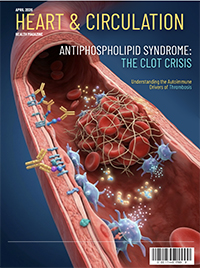 Our project focused on using an autoimmune disease, antiphospholipid syndrome (APS), as an example to explain the concepts of blood clotting. We started off with a case to explain that APS is a condition where the body's immune system mistakenly attacks healthy cells, which in this case, causes blood clot. We then moved on to talk about blood clotting in general, not just caused by APS. We brought up the Virchow’s Triad, which describes the three factors that the blood clot can arise from. Blood clot is more likely to form when there is damage to the blood vessel, when the blood itself becomes more “sticky”, and when the blood flow becomes slow. We also mentioned what else could go wrong if there’s a blood clot. The blood clot can travel through the blood vessel to different parts of the body, causing problems at that area. Some common areas include the brain, heart, lungs, liver, intestines, and dermal tissues. We chose to use a magazine to present our content because it allows us to use diagrams to explain ideas, effectively combine text and visuals, and engage the audience better than plain texts. Our topic is important and meaningful because blood clotting disorders usually develop with few symptoms but occur suddenly. As a result, most people may be unaware of an underlying problem until a serious condition occurs. This makes it important to raise awareness of the general public about how this disorder develops and why early attention to risk factors is important.
Keywords: Hemodynamic Disorders, Thromboembolism, Antiphospholipid Syndrome, Virchow's Triad
- PULSE Team Assignment - Team 23 (PDF, 338 KB)
PathBud: Exploring the Pathology of Budd-Chiari Syndrome - Team 29
Media Type: Website
Summary
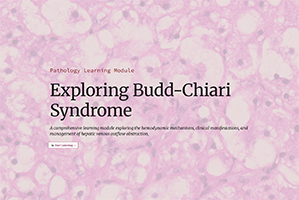 Our PULSE assignment focuses on Budd-Chiari syndrome, a rare but serious liver condition in which blood cannot properly flow out of the liver due to blocked veins. This disruption causes pressure to build up, reduces oxygen supply, and can lead to liver damage, swelling, and life-threatening complications if not recognized early.
To present this topic, we created an interactive website learning module designed to make complex medical concepts clear and engaging for a general audience. The website is organized into key sections, including liver anatomy, causes of the condition, how the disease develops, signs and symptoms, complications, and treatment options. It also incorporates videos, visuals, and quizzes to support different learning styles and reinforce understanding.
We chose this topic because it clearly demonstrates how a disruption in blood flow (a key concept in pathology) can affect organ function and overall health. Budd-Chiari syndrome is also relatively unknown, so increasing awareness can help promote earlier recognition and better outcomes for patients.
We selected a website format because it allows information to be presented in a structured, visual, and interactive way, making it easier to understand compared to traditional text-heavy formats. Users can move through the material at their own pace and see how different concepts connect.
Overall, this project aims to make complex medical information more accessible, raise awareness about liver disease, and highlight the importance of early diagnosis and treatment.
Keywords: Budd-Chiari Syndrome, Hepatic Venous Outflow Obstruction, Liver Disease, Portal Hypertension, Pathophysiology, Thrombosis
- PULSE Team Assignment - Team 29 (PDF, 279 KB)
Blood Clots: When Protection Becomes a Problem - Team 32
Media Type: Presentation
Summary
 We chose the topic thrombosis. Thrombosis is the formation of blood clot inside a blood vessel when it is not needed. Normal blood clotting is usually to help stop bleeding after an injury but thrombosis occurs when this process is unregulated. Thrombosis can block blood flow causing serious problems such as strokes, heart attack, etc. For this assignment, our group created a presentation and an animation at the end of it to explain thrombosis in a clear and structured way. We explored the roles of blood flow, vessel damage, and changes in blood that can increase risk of clotting. We chose this topic because thrombosis is a common and important medical condition that many people are affected by. We broke down some different concepts of thrombosis using different visuals, animation and also presentation itself. Our goal for this assignment was that those who have no to little background in biology or science will be able to understand this topic.
Keywords: Blood, Clot, Embolism, Thrombosis, Stroke, Aneurysm
- PULSE Team Assignment - Team 32 (PDF, 442 KB)
Anaphylaxis; When Food, Exercise, and Drugs Turn Fatal - Team 38
Media Type: Infographic
Summary
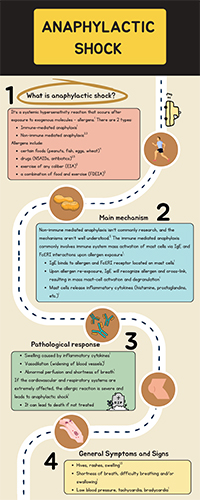 Our experiential assignment focused the mechanisms, causes, and types of anaphylactic shock. We decided to design an infographic containing the main features associated with each type of anaphylactic shock. We believe that an infographic provides interactive opportunities for audiences not familiarized with a topic to better grasp its significance and complexity through simplified, yet concise explanations of the material. Anaphylactic shock is a hypersensitive response to an allergen, which triggers an activation of immune cells called mast cells. Said mast cells become activated and release inflammatory molecules called mediators. These inflammatory molecules (histamine, prostaglandin, leukotrienes) act locally and systemically (throughout the body) to lower blood pressure, increase swelling, and reduce heart rate. In normal responses, these mediators help combat diseases through inflammatory action; however, these responses are exacerbated in the presence of allergens and the associated pathological response (IgE dependent and independent anaphylaxis). There are 2 types: immune-mediated anaphylaxis (IgE dependent) and non-immune-mediated anaphylaxis (IgE independent). IgE dependent anaphylaxis occurs through IgE and allergen interactions that activate mast cells, whereas IgE-independent anaphylaxis causes are not fully understood, but can be triggered by exercise or drugs. Correspondingly, the pathological issues caused by this exaggerated response are manifested in signs such as hives, rashes, shortness of breath, low blood pressure, irregular heart rate. Additionally, symptoms may present differently between individuals, but may include pain, fatigue, mental confusion. If the symptoms are severe, the anaphylactic reaction results in death. Overall, our assignment aims to provide additional and crucial information regarding anaphylaxis, as it is a potentially fatal condition, and cannot be resolved at home. Therefore, it is important for audiences to be aware of the many presentations and risk factors associated with it.
Keywords: IgE Antibodies, Non-Immune Mediated Anaphylaxis, Immune-Mediated Anaphylaxis, Anaphylactic Shock, Mast Cells, Degranulation
- PULSE Team Assignment - Team 38 (PDF, 219 KB)