

Search Website
What is Anti-Racism?
Note: The resources shared external to Western University are offered as points of consideration, not an implied endorsement.
Race
Race is a term used to classify people into groups based principally on physical traits (phenotypes) such as skin colour. Racial categories are not based on science or biology but on differences that society has created (i.e., “socially constructed”), with significant consequences for people’s lives. Race is not the same as ancestry. Racial categories may vary over time and place and can overlap with ethnic, cultural, or religious groupings (Ontario Government, 2022).
Racism
Racism "is any attitude, action, institutional structure, or social policy that subordinates persons or groups because of their racial group membership"(Sue and Spanierman, 2020). It is "prejudice plus power", which leads to disparities and inequities between groups of people based on their racial group because of the ideology of one race considered superior or inferior to another. It can be openly displayed in racial jokes and slurs or hate crimes, but it is also more deeply rooted in attitudes, values, and stereotypical beliefs perpetuated over time. Racism occurs at four levels or dimensions: internalized, interpersonal, institutional, and structural (Race Forward, 2023).
The Four Dimensions of Racism
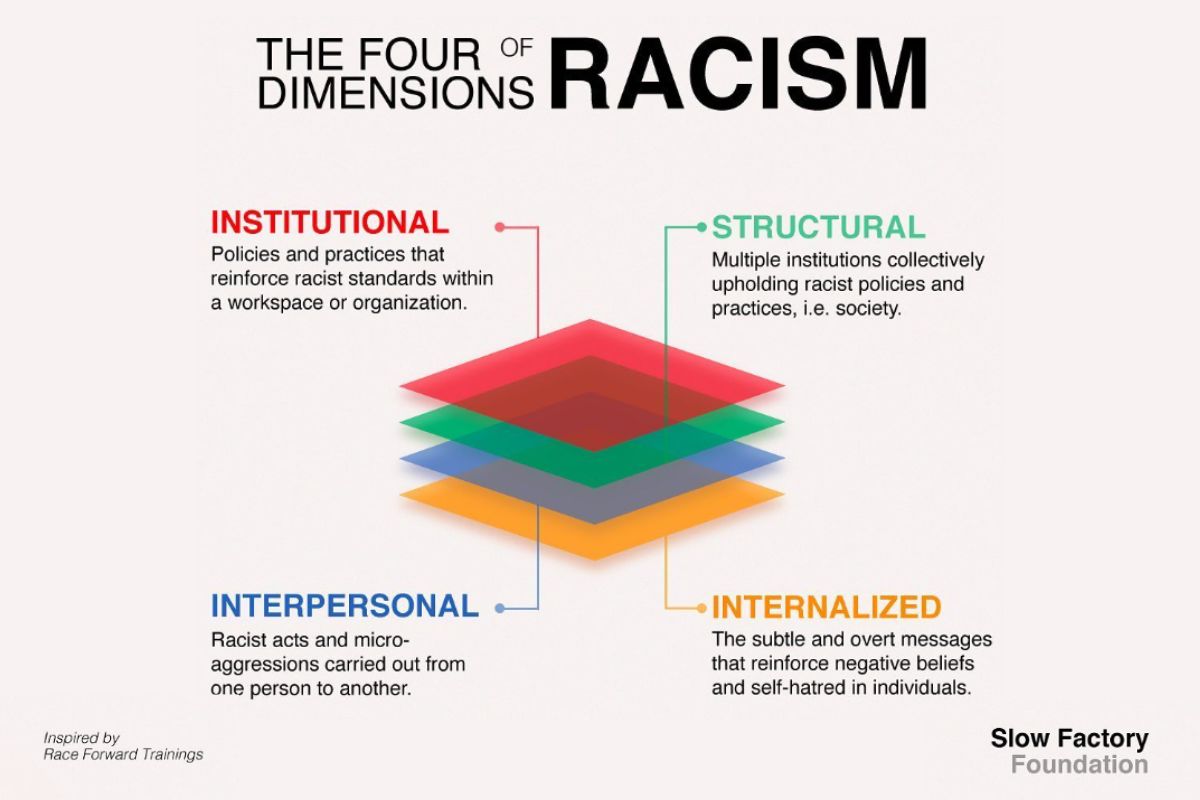
Individual Racism:
Internalized Racism
Internalized Racism lies within individuals. These are private beliefs and biases about race that reside inside our own minds. For some people, this can be internalized privilege, entitlement, and superiority; for people of colour, this can be internalized oppression. Examples: prejudice, xenophobia, conscious and unconscious bias about race, influenced by white supremacy (Race Forward, 2023).
Interpersonal Racism
Interpersonal Racism occurs between individuals, including bias, bigotry, and discrimination based on race. Once we bring our private beliefs about race into our interactions with others, we are now in the interpersonal realm. Examples: public expressions of prejudice and hate, and microaggressions between individuals (Race Forward, 2023).
Systemic Racism:
Institutional Racism
Institutional Racism occurs within institutions. It involves unjust policies, practices, procedures, and outcomes that work better for dominant groups with power, whether intentional or not. Example: A school district that concentrates students of colour in the most overcrowded, under-funded schools with the least experienced teachers (Race Forward, 2023).
Structural Racism
Structural Racism is racial inequities across institutions, policies, social structures, history, and culture. Structural racism highlights how racism operates as a system of power with multiple interconnected, reinforcing, and self-perpetuating components which result in racial inequities across all indicators for success. Structural racism is the racial inequity that is deeply rooted and embedded in our history and culture and our economic, political, and legal systems. Examples: The “racial wealth gap,” where White persons on aggregate have greater intergenerational wealth when compared to people of colour, resulting from the history and current reality of institutional racism in multiple systems (Race Forward, 2023).
Anti-Racism


Anti-Oppression
Though they go hand in hand, anti-oppression is not the same as diversity & inclusion. Diversity & Inclusion (which are defined in another tab) have to do with the acknowledgment, valuing, and celebration of difference, whereas Anti-Oppression challenges the systemic biases that devalue and marginalize difference. Diversity & Inclusion and Anti-Oppression are two sides of the same coin--one doesn't work without the other--but they are not interchangeable. (Simmons University Library, 2023).
Expand Your Understanding Through Western EDI’s Comprehensive Modules:
Expand Your Understanding Through Western EDI’s Comprehensive Modules:
Ontario Government. (2022, April 13). Glossary of Terms. Data Standards for the Identification and Monitoring of Systemic Racism. Retrieved from https://www.ontario.ca/document/data-standards-identification-and-monitoring-systemic-racism/glossary
Race Forward. (2023). What is racial equity? Race Forward. Retrieved from https://www.raceforward.org/what-racial-equity-0
Ontario Human Rights Commission. (n.d.). Racial discrimination, race and racism fact sheet. Ontario Human Rights Commission. Retrieved from https://www.ohrc.on.ca/en/racial-discrimination-race-and-racism-fact-sheet
Canadian Race Relations Foundation. (2023). Glossary of terms. Canadian Race Relations Foundation. Retrieved from https://crrf-fcrr.ca/glossary-of-terms/
University of Western Ontario. (2023). Policy 1.35 – Non-Discrimination/Harassment/Sexual Misconduct Policy. Retrieved September 11, 2023, from https://www.uwo.ca/univsec/pdf/policies_procedures/section1/mapp135.pdf PDF
Alberta Civil Liberties Research Center (ACLRC). (2021). Anti-racism. Alberta Civil Liberties Research Center. Retrieved from https://www.aclrc.com/issues/anti-racism/
Simmons University Library. (2023, January 9). Anti-oppression resources. Simmons University Library. Retrieved from https://simmons.libguides.com/anti-oppression