


Resilience part of the path to medicine for PhD graduate
By Cam Buchan
Known as “the philosopher,” Kenyan long-distance runner Eliud Kipchoge has a deceptively simple view of people and their potential.
“No human is limited.”
There are certainly few if any limits on Kipchoge, who has owned long-distance running through most of the first quarter of this century.
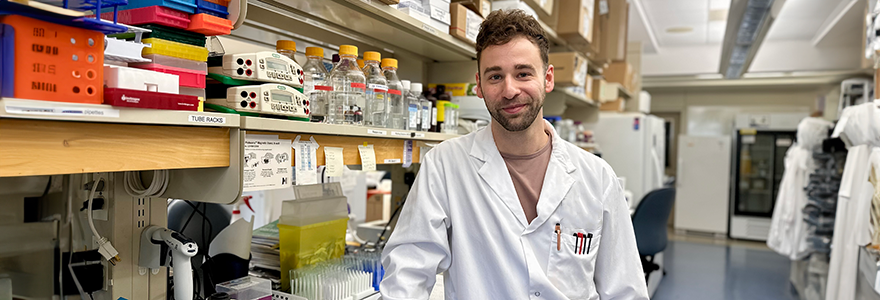
A distance runner himself, Michael Roes, PhD’24, has turned Kipchoge’s idea into his own personal philosophy, using it to power his view of life and the world. Now as Roes graduates from Schulich Medicine & Dentistry’s PhD program this week, literally stepping off the stage at Alumni Hall and into classes in Schulich Medicine & Dentistry’s medical school program, he reflects on an ongoing career at Western. Roes graduates during Western’s autumn convocation on October 23.
Roes’ path to medical school has been a journey of persistence and patience. He spent two summers as an undergraduate student and completed his undergraduate thesis project all in the lab of Dr. Fred Dick. After being waitlisted for medical school during the 2016-2017 cycle, Roes turned to the Master’s program in the Department of Pathology under Dick’s supervision in 2017 before transferring to the PhD program in 2019.
But these experiences – and medical challenges along the way – have taught Roes to push through the hard times because, well, life is a marathon not a sprint.
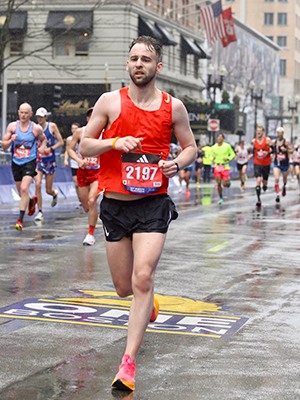 Michael Roes running the Boston Marathon. (Supplied)
“I think about the person I am now,” said Roes, who credits Dick for supporting him both personally and academically during his time in the program. “I have more confidence in myself and my abilities. I have more resilience in myself.”
Those strengths have certainly been tested. Roes was diagnosed with Type 1 diabetes at 20 years old.
“The day I was released from the hospital after my diagnosis, I realized I didn’t want people to see me differently,” said Roes, who ran cross-country through elementary and high school before taking time off for university. “It inspired me to get back into running, and I just decided to go for it.”
His initial goal was to qualify for the Boston Marathon; and after some intense training, Roes ran his first marathon – the Manitoba Marathon in Winnipeg in 2021 – in a time of 2:49, 11 minutes under the Boston qualifying time of three hours. He ran the Chicago Marathon in 2022 and the Boston Marathon in 2023 in a personal best of 2:46.
“It was an amazing experience and helped me realize diabetes isn’t something that defines or limits me. I hope to inspire others with diabetes to achieve their own dreams.”
Now with the Chicago and Boston events under his belt, Roes has his sights set on completing the rest of the “majors” of marathoning: The New York City race is planned for 2026; Tokyo, Berlin and London, England lie ahead.
For a future physician who has juggled marathon training, a PhD dissertation focused on investigating gene mutations that mediate resistance to targeted drug treatments in prostate cancer cells and acceptance into medical school, time management has got to be his secret weapon.
“It’ll be interesting to see how I can fit training into medical school,” said Roes with a smile. “But I’m going to do my best.”
This combination of research and medicine is something Roes hopes will provide better insights into being an effective physician.
“Coming from pathology and doing research in prostate cancer, I’ve definitely considered pathology or oncology as potential specialties, but being a Type 1 diabetic, endocrinology would be meaningful on a personal level,” said Roes. “Ideally, I want to be a physician my patients feel safe in coming to with their issues and that I feel confident in being able to help them.”
He’s certainly on the right track.


