

Search Website
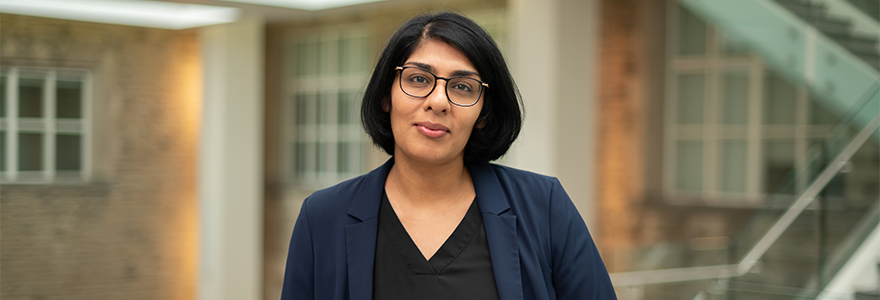
Evolving in equity: In conversation with Dr. Sukhi Bains
By Andrew Graham
The Associate Dean of Equity and Social Accountability is charting a path forward to a more inclusive community.
By Andrew Graham
Schulich School of Medicine & Dentistry is evolving in its commitment to social accountability and a more inclusive School community.
Helping to chart the path forward is the School’s newly appointed Associate Dean of Equity and Social Accountability Dr. Sukhveer (Sukhi) Bains, who is tasked with leading the Office of Equity and Social Accountability.
Bains previously served as the Acting Associate Dean of Equity, Diversity, Inclusion and Decolonization.
As she transitions into the role, Bains reflects on the evolution of the Office, as well as the School’s past and future inclusionary efforts.
The Office was established in 2022, and you led it in an acting capacity until your recent permanent appointment. In the three years you have been in this role, what are you most proud of?
In that first year, I talked to everyone in the broadest of terms. I learned about so many great initiatives that were already happening. What became clear is that the criticism that Schulich Medicine & Dentistry can do more is valid, but it’s also true that there was a lot of meaningful work happening. It just wasn’t connected. It was siloed.
So, one of the things I’m most proud of is helping build relationships and trust among people who were already doing equity work — most of it off the side of their desks. We worked to break down silos through communications and created a community of support to bring people together. Once people started connecting, incredible things happened.
For example, colleagues in nursing who are leading decolonization, anti-oppression and anti-racism work connected with faculty in the Doctor of Medicine program. That led to new teaching collaborations that are now very well received among learners and faculty alike. It wasn’t about building something entirely new, it was about amplifying and connecting what already existed.
I am so proud to work alongside Seidy Rayo in the Office of Equity and Social Accountability, as well as all the other members of our community – learners, faculty and staff alike – who continue to push this work forward.
The Office of Equity, Diversity, Inclusion and Decolonization is being renamed the Office of Equity and Social Accountability. Why did the School make this change, and does it reflect a new direction or focus?
Accountability, when grounded in humility and equity, is a relentless and powerful driver of social and institutional change. Professional health programs cannot and should not be responsible for all societal challenges, but we do have a unique privilege, negotiated on the premise of public good, to self-regulate and impact generations of health providers and leaders of the systems that can and do influence population health. Our responsibilities for truth and reconciliation as a school of health professionals and as a driver of research and education at Western are also central to this evolution. This is our lane.
By centring social accountability, the new name clarifies how the School puts equity, inclusion, anti-racism and decolonization into practice — through responsiveness to community needs, attention to structural inequities and contributions to fair and effective health systems. It reminds us that we are genuinely, and uniquely, accountable for action on these fronts.
You have stated in the past that work around EDID is always ongoing, so the School will never “be done” with advancing its social accountability mandate with respect to these principles. What specific, concrete strides or improvements can you point to that highlight our progress?
Social accountability means recognizing where we are responding to the needs of this region. The School’s launch of a clerkship program in Sarnia is a great example. It builds local capacity, gives learners exposure to the communities they will serve and strengthens regional health systems.
The new public health undergraduate program is another example of our School building capacity for real-world impact. The COVID-19 pandemic reminded everyone how critical public health is. Schulich Medicine & Dentistry created that program with intentionality by focusing on collaboration across campus and leveraging our expertise in infectious disease, emerging pathogens, social determinants of health and health systems. That’s what it means for this school to contribute to equity in health.
Lastly, I would like to point to the incredible partnership between Continuing Professional Development and our office that has resulted in the EDID Workshop series. It was created in response to clear faculty, learner and staff feedback for more equity-focused learning opportunities and it is off to a tremendous start. We are building and strengthening partnerships to scale the impact of this learning across Schulich Medicine & Dentistry and Western. We look forward to continuing and expanding this work for years to come.
The work of equity, anti-racism and decolonization has to be done with building relationships and trust first. As a School, we are not doing this work alone; we must do it in concert with where we are, who is here and who is not here. By breaking down barriers for engagement across Schulich Medicine & Dentistry, we ensure our programs, research and teaching are developed through the lens of equity and social accountability.
I think we’re doing great things, but we are also a work in progress.
You’ve said in the past that our learners are leading critical work to advance the School’s commitment to social accountability – can you elaborate on some of the ways you’ve seen students enact positive change in this space?
It has been amazing to witness and amplify the work of so many learners.
There are so many examples of this positive change happening in our community. The Indigenous Medical and Dental Student Association is one that comes to mind and the work they’ve done to connect with and support aspiring and current learners.
There’s also the Black Medical Students’ Association. Last year, they worked alongside London Health Sciences Centre and several other local community organizations to host the inaugural London Black Health and Wellness Fair, which happened again this year.
The Council on Reforming Equity, Diversity and Inclusion for Trainees (CREDIT) is made up of trainee representatives from each department. CREDIT was the first group in our community to publish information on the experiences of equity-deserving groups completing graduate training at Schulich Medicine & Dentistry. They’ve also made strides in supporting the facilitation of relevant workshops and training at the department level, along with supporting equity education as a milestone within graduate programs.
Learners are doing incredible work, and they’re doing this on top of rigorous programs and countless responsibilities. It is very important that we recognize that.
At the same time, I struggle with the fact that equity labour often falls disproportionately on those who experience inequity. Racism is not going to be fixed by those who experience it. We all share accountability.
What I see here is that learners are an immense source of strength and what I hope to help with is creating space for open dialogue and communication opportunities to value that work, recognize it as the labour that it is and grow from it.
This work can be extremely challenging and progress can come slowly. What gives you reason for optimism? What’s your reason for waking up and continuing to do this work?
This work is iterative, and change doesn't happen fast enough. I do this work knowing that I probably won't see substantive change in my lifetime, but if we don't do something now it's not going to change.
I have had the privilege of experiencing what equity in action looks like – we all have if we pay attention. We would not be where we are today without the labour of those who have come before us. I see it as a shared responsibility to carry that work forward.
We have an opportunity, and it’s on us to operationalize it when we can, without being paralyzed by the fear of doing something wrong.
Knowing there are many faculty, staff and learners who share this same belief is what gives me optimism.