


Search Website
Medical student builds pathways for Black representation and mentorship
By Jacquelyn LeBel
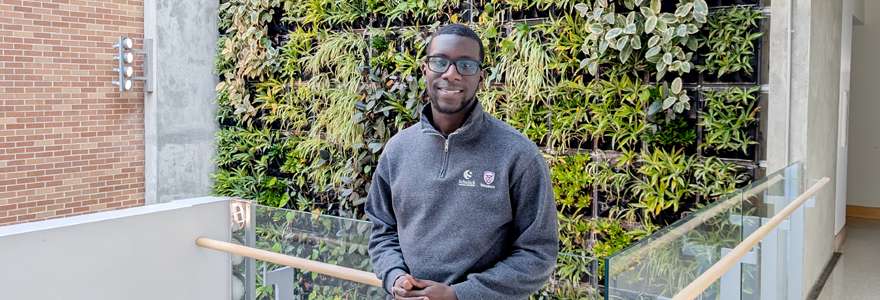
Cornelius Osei-Owusu serves as advocacy lead for the Black Medical Students’ Association
By Jacquelyn LeBel
For Cornelius Osei-Owusu, BMSc’24, community is vital to his experience in medical school – and now he’s working to build it for others.
“My community is the reason I’m here. There are a lot of things I wouldn’t have been able to do on my own; I’ve had a lot of support,” he said. “That’s why creating a sense of community for medical students is so important to me.”
A second-year student at Schulich School of Medicine & Dentistry’s Windsor Campus, Osei-Owusu serves as advocacy lead for the School’s chapter of the Black Medical Students’ Association (BMSA). In that role, he supports the admissions process for prospective students, including the Black Applicant Pathway, advocates for relevant curriculum updates and works with faculty and staff leaders.
His work unfolds against a broader backdrop of longstanding racial inequities in Canadian health care – from the underrepresentation of Black physicians to a history of exploitation within the medical system. The Canadian Medical Association reports that while Black people make up 4.7 per cent of Ontario’s population, they account for just 2.3 per cent of its physicians. Canada’s public health agency has also noted historic distrust of health authorities among Black communities, rooted in a legacy of exploitation “under the guise of science.”
I was drawn to service. I feel like the best way I can serve is through health care.
MD Candidate
“If you don’t understand that history, it’s harder to navigate and reduce some of the barriers,” said Osei-Owusu.
He also points to medical conditions that are more prevalent among Black populations, or that may present differently, emphasizing the importance of reflecting this in the curriculum.
His work with the BMSA began with a survey that drew nearly two dozen responses about the Black student experience at Schulich Medicine & Dentistry. Students identified a need for more mentorship opportunities with Black physicians, improvements to Black health content and greater visibility for the School’s BMSA chapter.
With this feedback, Osei-Owusu is now developing a one-on-one mentorship program with Black physicians in the community, facilitating conversations with the curriculum committee and undertaking a curriculum audit, as well as creating video content for the Black Applicant Pathway admissions website.
He is also focused on encouraging and supporting future medical students and post-secondary students more broadly. He helped revive the grassroots, student-led group BOLD (Black Outreach Leadership Directive), which aims to increase the representation of Black youth pursuing post-secondary education in Ontario.
“For younger students, it helps to see people who look like them in places they might want to be,” he said. “It gives them motivation and inspires them as well.”
Locally, BOLD has partnered with Black graduation coaches from Windsor-Essex school boards to speak with students and develop online programming. Osei-Owusu says outreach efforts are often led by older adults, such as faculty or recruitment staff, but representation from post-secondary students can feel more relatable.
“We still know some of their vocabulary and sayings from high school, so it’s not totally cringe when we say it too,” he said with a laugh.
Osei-Owusu’s strong sense of community and desire to give back is rooted in his childhood, through his family and the largely Ghanaian Christian church he attends in his hometown of Toronto. Being the elder brother of two younger sisters also shaped his interest in mentorship, he believes.
“I was drawn to service,” he said. “I feel like the best way I can serve is through health care and I’ve always been interested in the human body and how it works.”
He completed an undergraduate degree in medical sciences at Schulich Medicine & Dentistry before starting medical school.
At his church, he says, people are proud of him – and encouraged to know there will be a doctor from their community.
“For me, it’s about creating that same kind of supportive space, where Black students feel welcomed and can connect with others who share similar lived experiences.”