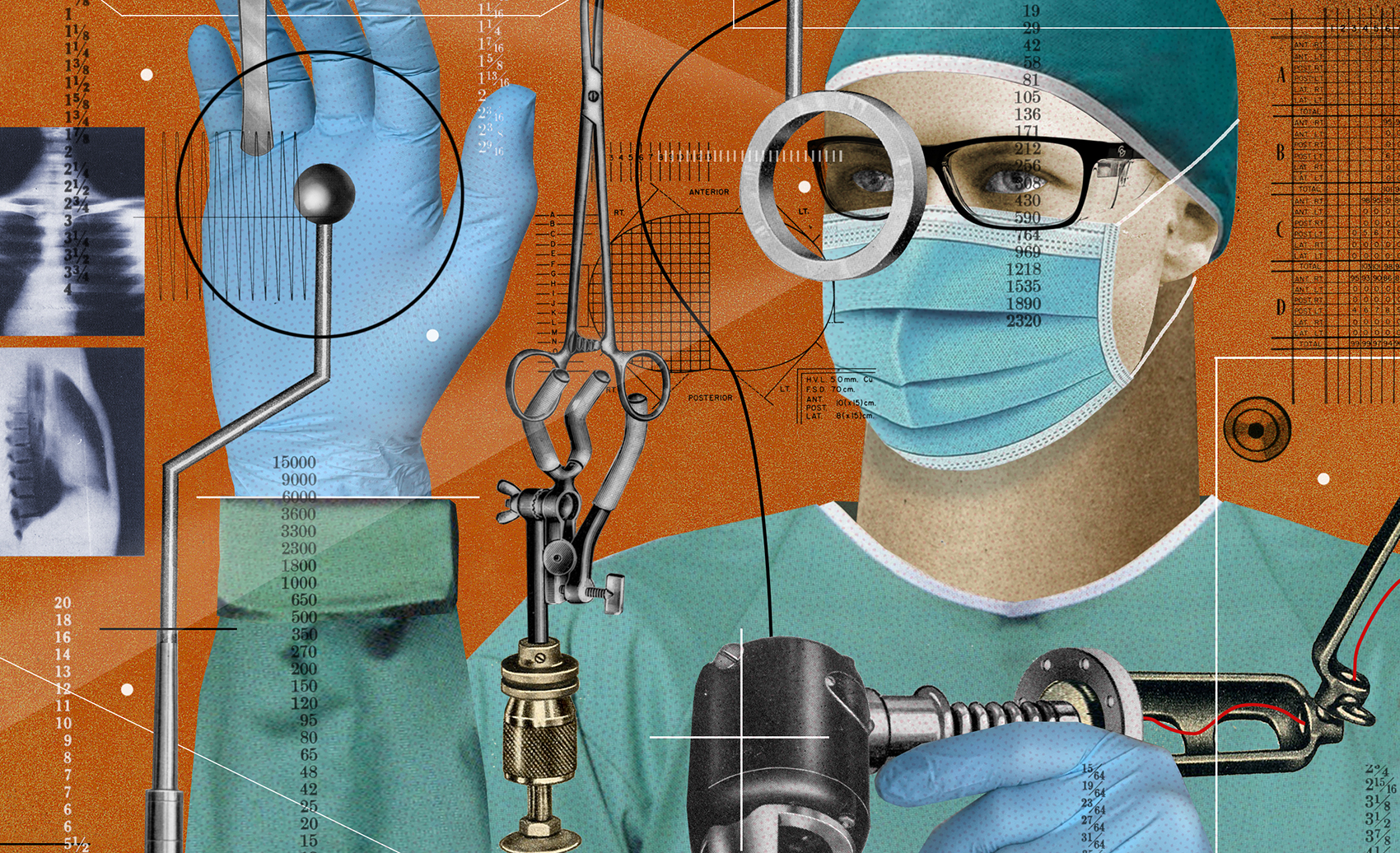



Revolutionizing the Way
Pain is Located and Treated
“Precisely locating pain is the key to treating it.” — Dr. Eldon Loh
At a London, Ont. hospital, Dr. Eldon Loh, MD’05, calls up a detailed 3D model of a human leg on his computer screen. The knee joint is exposed between the blue surgical sheet.
Loh, associate professor and recently appointed Earl Russell Chair in Pain Management, rotates the knee image with his mouse. “This digital anatomical modelling is revolutionary because it takes pain targeting to a new level of specificity,” says Loh, a pain management specialist at St. Joseph’s Health Care London. “Precisely locating pain is the key to treating it.”
With a few clicks, he removes the muscle and skin, exposing bones and nerves.
Sliding his mouse sideways, Loh lifts the joint off the virtual table, flipping it upside down to visualize the nerves from a completely different and immersive perspective.
“We can see how to place our needles in more optimal locations to increase the chances of capturing larger segments of these nerves, hopefully improving the degree and duration of pain relief.”
Much of Loh's work focuses on targeting nerves, applying heat or cold through a needle to block pain pathways to the brain. The relief can last up to 10 to 12 months.
Developed from his team’s anatomical research, the new digital models Loh uses will soon replace the older, hand-drawn versions.
The difference between the two is like the difference in detail between a traditional paper map and Google Street View.
The next phase of this technology, Loh says, will use virtual reality headsets. Through academic-industry partnerships, the technology may augment cadavers in training future pain specialists — using the digital imagery Loh and his colleagues have developed.
“It’s really all about improving our targeting of specific nerves to hopefully improve clinical success,” he says.
 In 2019, chronic pain cost upwards of $38 billion in health care spending and lost productivity, according to Health Canada.
Identifying New Brain Circuitry,
the Key to Pain Treatment 2.0
“I’m excited to see what we can build, and I foresee Schulich Medicine & Dentistry becoming an internationally recognized centre for pain neuroscience research.” — David Seminowicz, PhD
On Western’s campus, one of the multi-million-dollar MRI machines that David Seminowicz, PhD, professor in medical biophysics, relies on for his neuro-imaging research sits in a windowed room.
Among Seminowicz’s many research interests, migraine headaches are a priority. More than five million people in Canada know the excruciating feeling, two-thirds of them women.
In response to these high numbers, Seminowicz is using the MRI machine to watch the brain as it responds to the pain. Participants undergo hours of brain scanning over several days to study the claustrum — a poorly understood brain region involved in pain.
“We think that the claustrum receives an input signal when pain is initiated and then sends out signals to multiple brain regions to activate a network involved in cognition or attention,” Seminowicz explains.
“We are also examining whether this circuit is abnormal in people with migraine. We have identified a potential new circuit that could be targeted with new treatments.”
Migraine, like many chronic pain conditions, Seminowicz says, is difficult to treat primarily because we don’t fully understand the underlying mechanisms.
At the heart of his research is the quest to understand brain mechanisms.
He doesn’t believe chronic pain will ever be fully eliminated – our nervous system plays too vital a role in survival. But improving how pain is managed? That, he says, is within reach, with Schulich Medicine & Dentistry researchers playing a major role in a global effort.
As part of this effort, and with the help of generous philanthropic donations, two new postdoctoral fellowships in pain research have just been created at the School, marking a significant step toward deepening expertise and expanding leadership in this critical field.
“This is one of the best neuroimaging centres in Canada, which I’m really proud to be a part of,” Seminowicz says. “I’m excited to see what we can build, and I foresee Schulich Medicine & Dentistry becoming an internationally recognized centre for pain neuroscience research.”
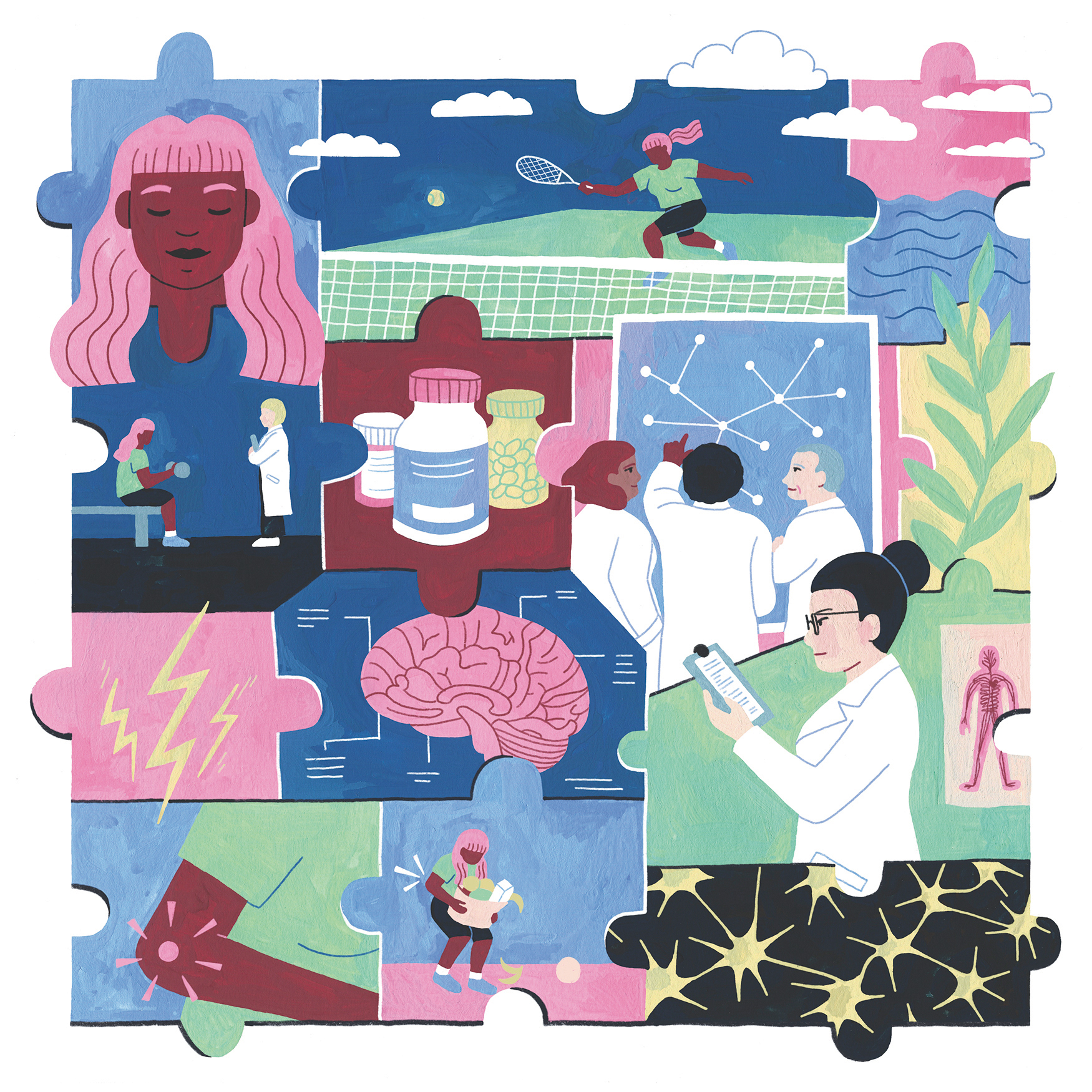 More than 5 million Canadians live with migraine.
Ensuring Pain Treatment is
Patient-Centred
“When you think about London’s research ecosystem, you have to think about the full picture – the researchers, infrastructure, surrounding communities and strong partnerships." — Joy MacDermid, PhD
On a scale of one to 10, describe your pain, the doctor says.
We’ve all encountered this directive at one point in our lives.
While muttering our answers, the most important question lingers silently unanswered: is it possible to measure our own pain accurately and objectively, let alone the pain of others?
This profound question has often been at the heart of Joy MacDermid’s work.
A professor and Canada Research Chair in Musculoskeletal Health Outcomes and Knowledge Translation, MacDermid, PhD, and co-director of the Roth | MacFarlane Hand and Upper Limb Centre at St. Joseph’s, has led efforts to measure pain and improve treatment outcomes.
Her research focuses on developing tools to assess pain, function and quality of life following injury – particularly in the hand, wrist and upper limb – and designing patient-centred rehabilitation programs to reduce the transition from acute to chronic pain. She’s also led national studies on return-to-work.
Pain is personal and our experiences with it are influenced by myriad factors, a complex intersection of our lived experiences and whatever ailment we are dealing with.
In other words – if you think your pain is a 10 out of 10, doctors treat it as such.
“We know that the way that the brain interprets the brain experience is affected by many things,” explains MacDermid, co-director of the Roth | MacFarlane Hand and Upper Limb Centre at St. Joseph’s. “This includes life experiences of trauma or abuse, pain-related expectations due to gender or culture, and prior experiences with the health-care system and pain relief interventions.”
Because of this complexity, she believes it’s vital to measure pain effectively.
“We have made progress in measuring pain from the patient’s perspective and co-designing interventions to better manage pain after injuries, surgeries and arthritis,” says MacDermid.
Chronic pain is a major problem in Canada. Five to 10 per cent of people with an acute injury or surgery will go on to have chronic pain that can be unrelenting and highly disabling.
It’s also one of the biggest drivers of opioid use, and a contributing factor in Canada’s deepening opioid crisis. The economic toll is staggering. In 2019 alone, chronic pain cost upwards of $38 billion in health-care spending and lost productivity, according to Health Canada.
“Once people have chronic pain, it is very difficult to manage,” MacDermid says. “We know that the best way to manage chronic pain is to prevent it from happening in the first place. We hope to prevent people transitioning from acute pain to chronic pain.”
Many Minds, One Mission:
Easing the Burden of Pain
“We know that the best way to manage chronic pain is to prevent it from happening in the first place." — Joy MacDermid, PhD
Although Loh, Seminowicz and MacDermid often work on differing sides of the pain spectrum, they are united by one common goal – helping people who are unable to enjoy their lives and contribute meaningfully because of pain.
Schulich Medicine & Dentistry’s ability to bring together multiple specialists in differing disciplines who share a common goal is a key part of solving the problem of pain – from prevention to mitigation to treatment.
That momentum includes a $65-million investment in workplace injury and illness research, led by Lawson Research Institute of St. Joseph’s Health Care London.
The historic grant – one of the largest of its kind in Canada – will support research to better understand, prevent and manage occupational health challenges, including pain-related disability.
“When you think about London’s research ecosystem, you have to think about the full picture – the researchers, infrastructure, surrounding communities and strong partnerships," MacDermid says. "It’s that combination, and a commitment to collaboration, that makes it truly unique in Canada.”