


Search Website
From patient to community champion
By Kurt Kleiner
After surgery ended her seizures, Karen Fisher built a grassroots movement raising funds, awareness and hope for people living with epilepsy
By Kurt Kleiner
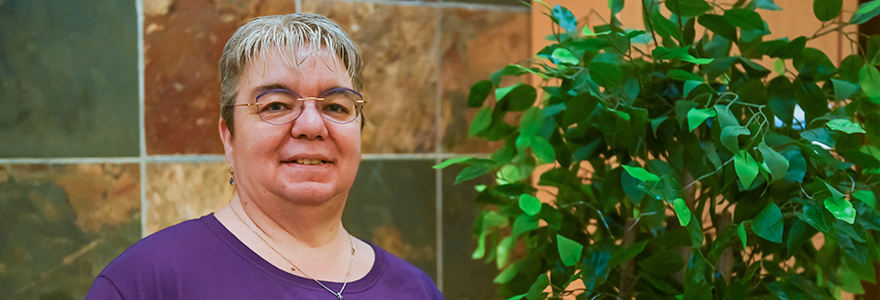
Karen Fisher was diagnosed with epilepsy when she was only 11 months old. As a teenager the fear of having a seizure limited her social life. It also kept her from driving, a major issue in the small town of Ashton, Ontario, where she lived.
“I didn’t get involved in things. I didn't do things because I never knew when I was going to have a seizure,” she said. “If I had to go somewhere, I needed to have a family member drive me. There were definitely impacts on my family.”
The condition was only partially managed by medications, and by the time she was 30 the seizures were becoming so frequent she was having a hard time doing her job as an accountant. That’s when she finally found her way to neurosurgeon Dr. David Steven.
Steven is chair and head of clinical neurological sciences at Western’s School of Medicine & Dentistry and London Health Sciences Centre (LHSC), and surgical co-director of the epilepsy program at LHSC.
In 2008, he performed surgery, removing a small portion of the brain that had been triggering Fisher’s seizures. Eighteen years later, Fisher remains seizure free.
“He told me I should have had this surgery when I was 18,” said Fisher. “It stopped my seizures, and it certainly changed my life.”
Today, Fisher runs her own accounting firm. She also spearheads Fisher Family and Friends for Epilepsy, a grassroots initiative that so far has raised more than $360,000 for epilepsy research and awareness.
“After surgery I got a second chance at life. I asked myself, what's my way of paying it forward?” she said.
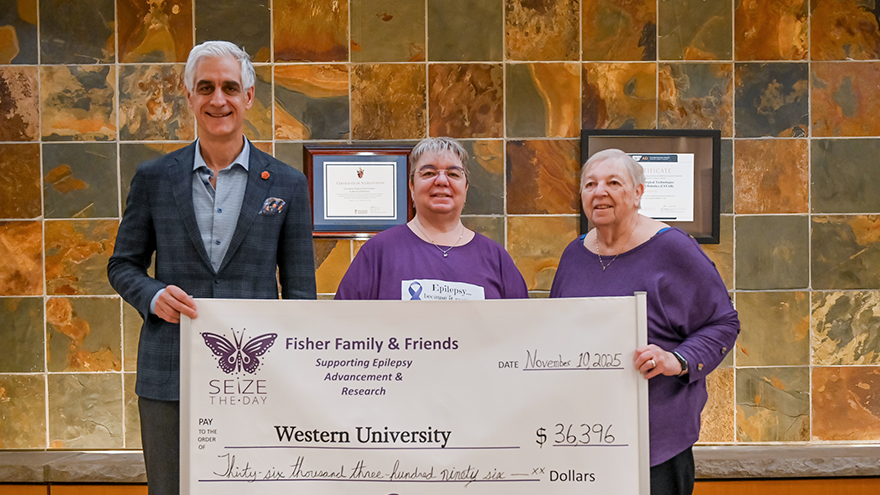
Dr. David Steven (left), Karen Fisher (centre) and Karen's mother, Helen (right) celebrating the 2025 contribution from Fisher Family & Friends. (Megan Morris/Schulich Medicine & Dentistry)
Less than a year after her surgery, Fisher organized her first event. It was a celebration of Purple Day, an epilepsy awareness event that takes place annually on March 26, held at the local hospital where her mother worked as a nurse.
“We challenged the staff to dress in purple. We had treats. It wasn't even meant to be fundraising. It was meant to raise awareness,” she said.
But as part of the awareness campaign, volunteers sold baked goods for donations and soon found themselves raising $4,000 each year.
Today, the group runs a number of fundraisers, including dances and online auctions. The major events are two different scrapbooking “crops,” paper crafting events which attract up to 80 people for a day of socializing and crafting.
“I was at their fundraising event on the weekend. I mean, it was out of control,” said Steven admiringly. “I know people who host once-a-year galas, or make one-time big donations. But I've never heard of anyone else with this grassroots effort. It's really remarkable.”
Although surgery is now a common treatment for epilepsy that doesn’t respond to medication, patients still often suffer delays getting a referral to a surgeon.
“It's unfortunate, but it can still take 10 to 20 years from the time someone's diagnosed to when they have surgery,” said Steven.
That’s part of why epilepsy awareness is so important. And Steven says the funding from Fisher and other donors is also vital. “It’s critical. If we have a research project that we want to work on, we can work on it. If we want to train someone, we can train them,” he said.
Donations have also funded research projects that improve diagnosis and treatment. For instance, the money is funding research that helps improve how doctors interpret data from electroencephalograms, a test that measures electrical activity in the brain, so they can more accurately locate the area of the brain causing seizures.
For Fisher, the campaigns are a way of raising awareness, building community and giving back to the medical providers who helped her.
“I lived with uncontrolled seizures for so many years. I didn’t know any other way of life. Dr. Steven and his team did something for me that I never imagined possible,” she said.
“I’m happy we could bring a community together and start to change the lives of others, all the while giving back and saying thank you to a team that changed my life.”