


Search Website
Western researchers turn clinical questions into better patient care
By Houda Houbeish
Clinical Trials Day highlights collaborative research advancing new therapies and technologies
By Houda Houbeish
From less invasive kidney cancer therapies to next-generation robotic systems for spine surgery, clinician-scientists at Western University’s Schulich School of Medicine & Dentistry are moving promising discoveries closer to patient care.
Partnerships with local hospitals and research institutions underpin this work, making clinical trials possible. Together, London’s health-care community provides the infrastructure, expertise and collaborative environment needed to move ideas from early concepts into clinical research and, ultimately, patient care. This shared effort reflects a collective investment in turning discovery into impact and strengthening the future of health care in Southwestern Ontario.
“Through its support of clinical trials, Schulich Medicine & Dentistry is helping foster a strong culture of evidence-based research in collaboration with its hospital and research partners,” said Dr. Amit Garg, professor and associate dean of clinical research.
“We are focused on enabling world-class trialists here in London who can advance clinical research and strengthen the local health-care system through innovation and improved patient care," added Garg, who is also a nephrologist at London Health Sciences Centre (LHSC) and scientist at London Health Sciences Centre Research Institute (LHSCRI).
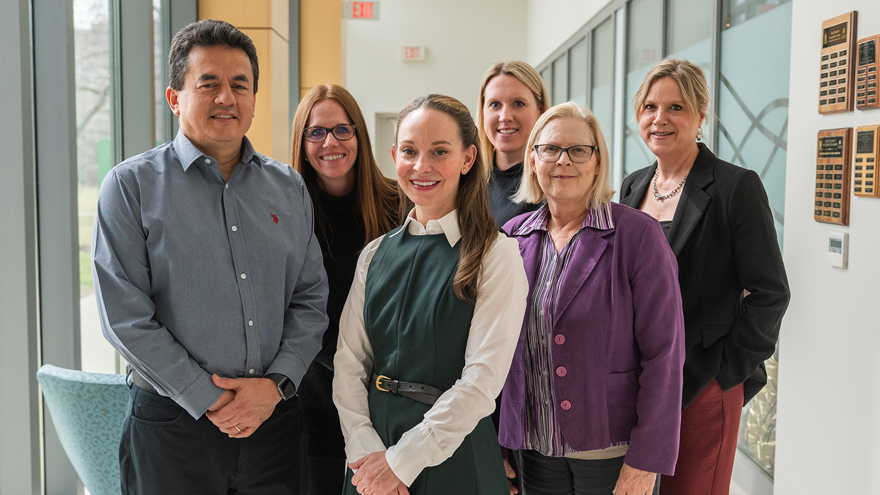
Dr. Sonja Reichert (centre) and members of the clinical trials research team (L to R) Mauricio Marin, Marnie Orcutt, Sue Miner, Cathy Thorpe and Kimberly Champion. (Megan Morris/Schulich Medicine & Dentistry)
Reimagining diabetes care
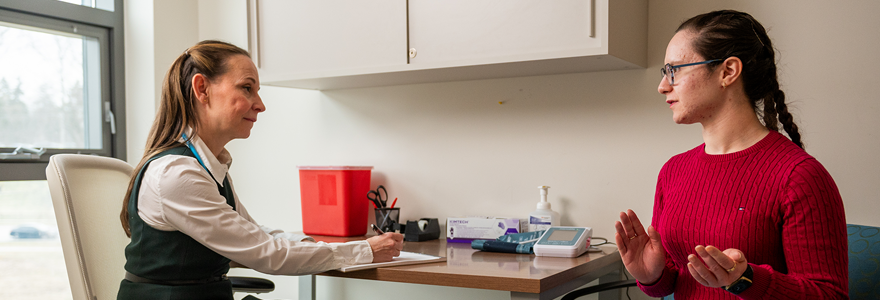
For many people living with Type 2 diabetes, insulin treatment is a daily, often demanding routine that can shape every part of life. Dr. Sonja Reichert, associate professor in family medicine and holder of the Brian W. Gilbert Research Chair in Primary Care Research, is testing whether that burden could be reduced by replacing daily insulin injections with a once-weekly option that may make treatment simpler and more manageable for patients.
“For patients, reducing 365 injections per year to 52 represents a substantial reduction in treatment burden,” said Reichert, who serves as medical director of the Primary Care Diabetes Support Program at St. Joseph's Health Care London.
“The goal is to determine whether this simpler regimen can safely maintain glucose control while improving quality of life and access for patients who may otherwise struggle with daily injection management.”
Through the EFFICIENT real-world trial, Dr. Reichert is comparing a once-weekly insulin injection (insulin icodec) with standard once-daily insulin in real-world clinical settings and across diverse patient populations.
While once-weekly insulin has already been approved in Canada, its use in practice remains fairly low, currently only covered by private insurance. At present, access is limited to patients with private or third-party insurance, leaving gaps for those relying on provincial drug programs or income assistance.
“This is where pragmatic clinical evidence could help with access,” Reichert said. “If we can show that this approach is both safe and effective in everyday practice, it strengthens the case for broader public coverage.”
She also sees the study as addressing a broader gap in how diabetes research is conducted in Canada, where most clinical trials are not led by primary care physicians despite diabetes care being delivered largely in primary care.
“There’s real value in having family physicians contribute directly to the research because we see the full spectrum of patients,” she said.
For Reichert, the goal is for trials like EFFICIENT to better reflect the diversity of patients seen in everyday practice, including those historically excluded due to language, social or systemic barriers.
Expanding treatment options for kidney cancer patients
While surgery remains the standard treatment for kidney cancer, it is not suitable for every patient. Some individuals cannot safely undergo a major operation, while others have tumours that are difficult to treat with existing approaches.
To address this gap, Dr. Derek Cool, associate professor in medical imaging, is leading a clinical trial at LHSCRI to evaluate a new, less invasive treatment option known as Y90 radioembolization. The goal is to expand care for patients who currently have limited alternatives to surgery.
The treatment works by delivering tiny radioactive particles directly to the tumour through its blood supply. The goal is to damage or destroy cancer cells while limiting harm to surrounding healthy tissue.
“A combination of clinical observation and emerging evidence made me think it was worth investigating whether this approach could be effective in treating kidney cancer,” said Cool, an interventional radiologist at LHSC and associate scientist at LHSCRI.
The approach has already been used successfully for more than 20 years to treat liver cancer, and researchers in Australia started studying whether it can work for kidney cancer as well.
So far, six patients have received the treatment in London, and early results are encouraging.
“I'm encouraged by the early response to the treatment. Our goal is to assess how the tumours look at one year, as kidney cancers tend to be very slow growing,” said Cool.
The study is one of only a few worldwide to explore this approach for kidney cancer. If the results continue to be positive, the treatment could eventually become another option alongside surgery, ablation and traditional radiation therapy, giving patients more choices in how their cancer is treated.
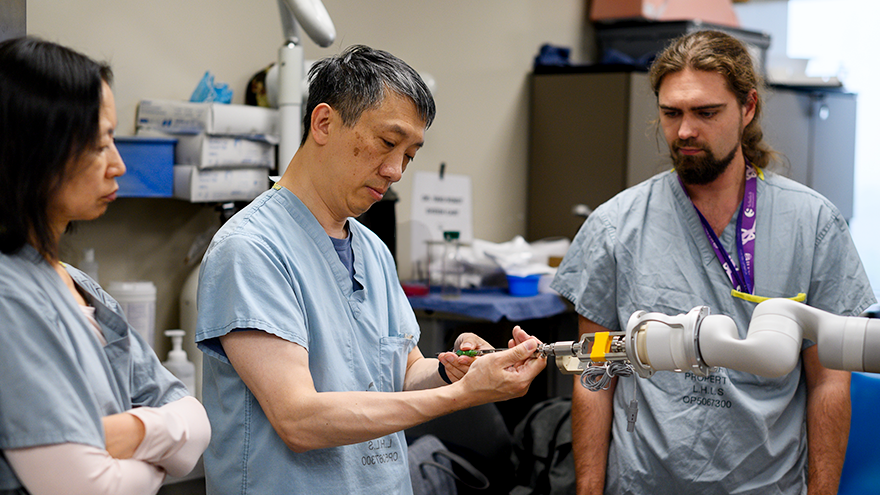
Dr. Victor Yang and his team have launched first-in-human studies to test robotic-assisted spine surgery. He is pictured in his lab at London Health Sciences Centre. (Megan Morris/Schulich Medicine & Dentistry)
Advancing robotic-assisted spine surgery
Dr. Victor Yang is developing an international clinical trial at LHSCRI to test whether a next-generation robotic system can improve spine surgery by making procedures more precise, consistent and data-driven.
If proven effective, robotic-assisted procedures may help reduce hospital stays, decrease pain, shorten recovery times and lower the likelihood of revision surgeries, especially for patients with osteoporosis.
“Most surgical robots today are designed for specific tasks and often use a single robotic arm,” said Yang, professor of neurosurgery, medical imaging, orthopedic surgery and medical biophysics.
“The system we developed is more humanoid in function, with greater mobility and movement around the operating room,” he added. “The goal is not just to mimic human movement, but to improve on human limitations by creating a system that is steadier, more precise and better able to visualize surgical anatomy.”
In 2024, the team launched first-in-human studies using the newly designed robotic system at LHSCRI, advancing the technology from laboratory development into clinical testing.
“I think this stage represents the maturation of the technology, evolving beyond the early experimental phase,” said Yang, who is also a neurosurgeon at LHSC and researcher at LHSCRI.
Clinical trials are the critical bridge between scientific discovery and patient care. On Clinical Trials Day (May 20), the work of clinician-scientists like Drs. Cool, Reichert and Yang highlights how medical research helps advance safer surgeries, less invasive treatments, shorter recoveries and improved care for patients.
Learn more about how Western is optimizing health for all.