


Search Website
Western receives $2.9M to expand oral health access and reimagine how future dentists learn
By Emily Leighton
New federal investment will strengthen community partnerships, enhance clinic operations and prepare graduates for a changing dental care landscape
By Emily Leighton
The stories echo across community clinics and outreach centres – people avoiding dental care after past experiences, young adults who never learned to brush properly, families unsure of how to navigate new federal coverage.
Taken together, these accounts reveal a persistent gap between oral health needs of specific populations and the systems designed to meet them.
Now, a major federal investment aims to align care more closely with community needs. Western University’s Schulich School of Medicine & Dentistry has received up to $2.9 million through Health Canada’s Oral Health Access Fund (OHAF) to complement the Canadian Dental Care Plan (CDCP) and expand care for communities that continue to face barriers.
“This investment allows us to reach people who, for many reasons, still aren’t receiving the care they need,” said Dr. Carlos Quiñonez, vice dean and director of dentistry. “It will also help ensure dental graduates are ready for the new realities of practice.”
Strengthening access
The first project, approximately $600,000 over one year, will help the School reach individuals who are uninsured or may experience delays or limitations when accessing the CDCP.
The funding will also enhance the School’s recently upgraded clinic management system, building on improvements already underway to strengthen communication and improve the patient experience.
“These enhancements allow us to connect with patients more effectively,” Quiñonez said.
The second project – nearly $2.5 million over three years – will expand the School’s community-integrated model of dental education and deepen partnerships with organizations across the region, including the Oxford County Community Health Centre, The Wright Clinic, Northwest London Resource Centre, Southwest London Neighbourhood Resource Centre, Cross Cultural Learner Centre, Youth Opportunities Unlimited, Regional HIV/AIDS Connection and Moose Factory Dental Clinic at Weeneebayko General Hospital in Northern Ontario.
The expanded model will strengthen the School’s focus on professionalism and social accountability, preparing students to provide culturally safe and person-centred care in diverse community settings
A curriculum built by community
A central element of the initiative is developing a curriculum grounded in lived experience and person-centred practice. Led by Dr. Abbas Jessani and Sarah McLean, PhD, the work builds on years of collaboration in community-engaged learning and oral health outreach.
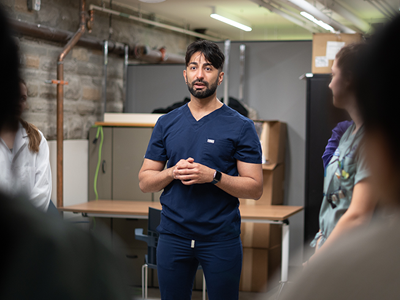
“Many of the patients we work with experience stigma in dental settings,” explained Jessani, assistant professor and academic lead of community service learning. “We’re training students to think outside the box – to understand the broader social factors that shape a person’s oral health and deliver care in ways that actually work for the communities they serve.”
The curriculum will embed community voices directly into the classroom, inviting individuals from partner organizations to share their experiences accessing dental care. Graduate students will also conduct focus groups at community sites to help define what person-centred care should look like, with these insights shaping new teaching modules, assessments and case-based learning resources.
For students, the impact is transformative. “When trainees meet people in their own environments, they begin to understand the social determinants of health in a very real way,” said Jessani. “It leads to practitioners who lead with compassion and humility.”
“It helps students connect with the humanity in their work,” added McLean, associate professor in anatomy and cell biology. “When they slow down and build trust, the outcomes are better for everyone.”
A model for the future
With approximately nine million Canadians eligible for the CDCP, Quiñonez says the School is preparing for this moment of change. The OHAF investment, he notes, aims to ensure students receive the training they need by strengthening clinic operations, expanding distributed education and contributing to a scalable model for future training programs.
“We will continue delivering exceptional oral health education and care for our region,” he said.