


Search Website
The pianist in the operating room
By Emily Leighton
Dr. Cohen Chaulk’s path to medicine shapes how he trains as a surgeon
By Emily Leighton
When Dr. Cohen Chaulk talks about surgical training, he starts with piano practice.
It’s not an obvious place to begin. But for Chaulk, the habits that matter most were formed in the hundreds of hours he spent at the keys, long before the operating room.
As a classical pianist, he trained in environments where perfection wasn’t attainable. “My piano teacher did not believe perfection existed,” he said. “There was always something to fix or improve.”
The lesson stuck.
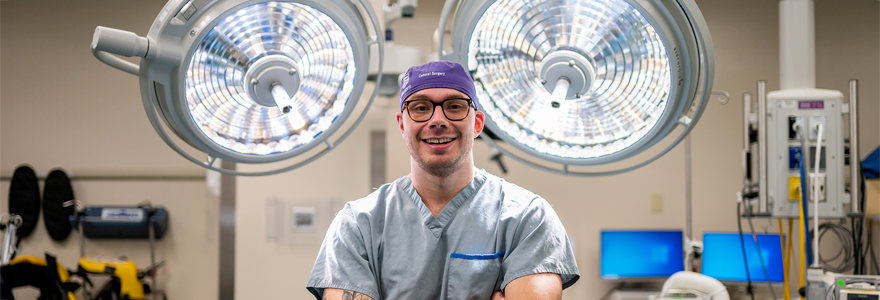
Now a fourth-year general surgery resident, Chaulk finds himself drawing on those same hard-won skills – discipline, repetition, goal setting and comfort with critique. Surgery, like music, rewards patience and practice.
"I learned the value of practice early on,” he said. “For me, it’s a huge part of being a surgeon.”
Born and raised in Corner Brook, Newfoundland, Chaulk did not grow up imagining a future in medicine. His early focus was split between music and sport.
He played competitive volleyball, and moved to St. John’s during his final year of high school to train at a higher level.
Music came next. At Memorial University, he pursued a degree in piano performance without a clear sense of where it would lead.
The emotional intelligence that comes from studying the arts and fine arts is invaluable. It's helped me navigate the human side of medicine.
General Surgery, PGY4
Medicine entered the picture gradually, largely through friends who had already made the leap from music to medical school. Chaulk began to explore the possibility himself, staying open and curious about what might come next.
The turning point came during a summer research internship in Cape Town, South Africa, where he worked with a cardiothoracic surgeon. Mornings were spent on research. Afternoons often ended in the operating room, observing bypasses and valve replacements.
“That’s when I decided, well, if I’m going to be a doctor, I might as well be a surgeon,” he said with a laugh.
While studying for the MCAT, Chaulk completed a master’s degree in music theory at Western’s Don Wright Faculty of Music.
He then went on to earn his MD at the University of Saskatchewan, where his interest in surgery took shape. And that path eventually led him to the general surgery residency program at Western’s Schulich School of Medicine & Dentistry.
“Our program is known to be very hard-working, very demanding,” he said. “We get a lot of independence early on in residency, and we’re trusted and respected by the team to handle that.”
Chaulk has embraced the program's culture of collaboration and mentorship. He sits on the residency program committee, an experience that has deepened his interest in teaching and academic medicine. He enjoys working with junior residents and sees education as a central part of his future practice.
Looking ahead, he plans to pursue a fellowship in thoracic surgery, a specialty that appeals to him for its technical difficulty and collegial culture.
“These are big, complex operations, so it’s never boring,” he said. “I’ve also never met a thoracic surgeon who didn’t love their job. Everyone is extremely supportive and welcoming.”
Alongside his clinical training, Chaulk completed a second master’s degree in surgery, focused on improving trauma care for patients in rural and remote communities.
For a Newfoundlander, the work is personal. Distance from tertiary care can shape outcomes in life-altering ways, and his research examines how systems might better respond – through faster transfers, improved coordination and rethinking how specialized care is delivered across vast geographies.
Threaded through all of his extensive training is a perspective shaped long before medicine.
“The emotional intelligence that comes from studying the arts and fine arts is invaluable,” he said. “It's helped me navigate the human side of medicine.”
Chaulk returns to the piano bench when he can, recently performing at a thoracic surgery holiday gathering.
“It’s important to hold on to the things that make you happy outside of medicine,” he said. “It’s what keeps you human.”