

Search Website
Students bring diverse stories, health education to young readers
By Houda Houbeish
Kids Health Shelf initiative creates stories where children see themselves represented
By Houda Houbeish
Stories can be a child’s first window to the world. But growing up, Nadith Ranasinghe, BSc’25, a second-year medical student at Western’s Schulich School of Medicine & Dentistry, rarely saw children of colour or immigrant families in the books he read.
Today, Ranasinghe is helping create children’s books that reflect these diverse experiences and make health-related topics more accessible to young readers. During his undergraduate studies at Western, he founded the Kids Health Shelf initiative with his classmates to give students a creative outlet and produce stories that resonate with young readers.
“Our goal is to give students a space to be artistic while also giving books to children that reflect their diverse experiences and journeys in life,” said Ranasinghe.
To date, Kids Health Shelf has produced four stories and donated copies to the Children’s Health Foundation and Children’s Hospital at London Health Sciences Centre in London, Ont.
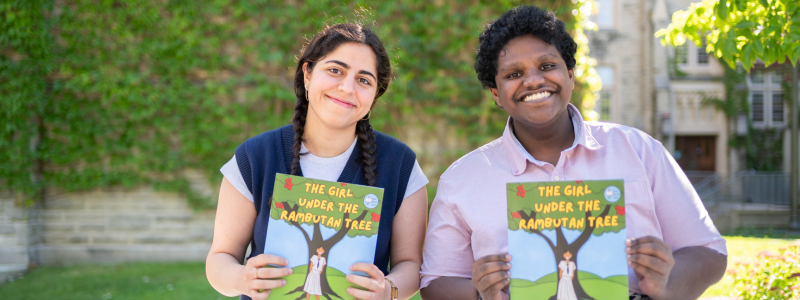
The club’s first story, published in 2024, was The Girl Under the Rambutan Tree. It drew on the childhood memories of Ranasinghe’s mother, Deepika, who grew up in Sri Lanka.
Despite growing up in poverty, his mother was determined to build a better future for herself. She studied medicine and became an anaesthesiologist before immigrating to Canada in 2012, where she worked as an infection control nurse. At the time, Ranasinghe was eight years old.
“My mother left her medical career behind to give my little sister and me a better life. I wanted to write about that sacrifice,” he said. “In many ways, this book is a tribute to her. I made her the main character, and the story is based on her childhood in Sri Lanka.”
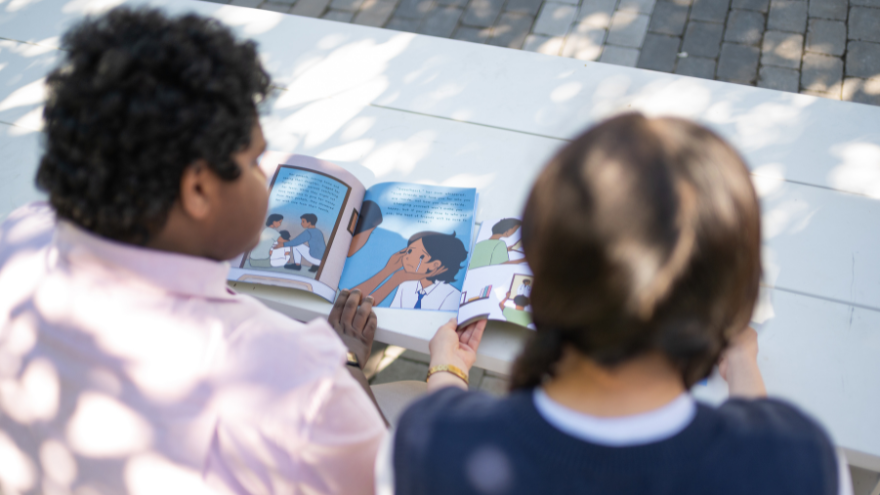
To date, Kids Health Shelf has produced four stories, including The Girl Under the Rambutan Tree. (Megan Morris/Schulich Medicine & Dentistry)
Other students in the club are focused on making complex health and science topics more accessible.
For Bahareh Rahimi Shahmirzadi, a medical sciences student specializing in microbiology and immunology, her experience as a picky eater inspired a book about the microbiome and healthy eating.
“I feel that having a book that explained the science in a way I could understand would have helped me overcome my picky eating,” said Rahimi Shahmirzadi.
She wrote and illustrated Microville: The Tiny Town Where Everyone Belongs over the summer of 2026. The book translates scientific concepts into memorable characters that children can understand.
For example, there's Fiona Fibre, who helps digest the fibre we eat, and Vita Vitamin, who turns food into vitamins our bodies can use.
“I focused on turning science into little characters that might be easier for kids to understand,” she said.
This November, the team plans to donate copies of its fourth book, Arjun and The Championship Sigh, to children in Guyana. Team member Avin Sharma, a medical sciences student with Guyanese roots, hopes to give back to his community through the donation. The story follows a cheerful brain named Arjun who helps Leo, a young football player, manage pre-game anxiety by teaching him a simple breathing technique. It aims to help children understand anxiety and equip them with an easy tool for managing it.
They are also working with Dr. Jamaica Cass, a primary care physician at Tyendinaga Mohawk Territory, on a book that brings more Indigenous representation into children’s stories.
“We are working on a story about Dr. Jamaica Cass who, despite all the adversity she faced, was able to earn her MD and PhD degrees and return to her community to help and give back,” said Ranasinghe.
For Ranasinghe and his peers, the hope is that young readers will see something of themselves in the stories they create. “When children see themselves in stories, it gives them the confidence to imagine themselves achieving things they may not have thought possible.”