


Search Website
Rethinking public health in an age of mistrust
By Emily Leighton
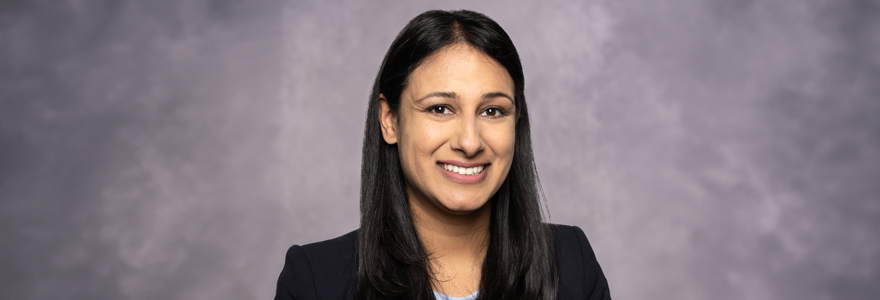
As Medical Officer of Health for York Region, Dr. Fareen Karachiwalla, MD’11, navigates misinformation, emerging health threats and public trust
By Emily Leighton
During her medical training, Dr. Fareen Karachiwalla, MD’11, never saw a single case of measles.
Now, she's navigating its resurgence at the highest level.
“Our traditional approaches just don't work anymore,” she said, pointing to a public health landscape grappling with misinformation and declining trust. "We need to be more humble than we’ve been before."
As Medical Officer of Health for York Region, Karachiwalla serves a population of more than one million people across nine municipalities. The job is part epidemiologist, part strategist and, increasingly, a full-time communicator.
"People are getting their information in completely different ways now,” she said. “Our whole communication presence needs an overhaul, to be more transparent and more people focused.”
Karachiwalla's interest in public health began taking shape in medical school – first with an observership at the Middlesex-London Health Unit and later, in Geneva, during a summer internship at the World Health Organization.
At Schulich Medicine & Dentistry, she found a supportive and motivating community. Mentors in infectious disease and public health offered an early glimpse into a field that, at the time, largely operated behind the scenes.
“These early training experiences opened up a whole new world beyond clinical medicine that I wouldn’t have considered,” she said.
As a resident in public health and preventative medicine at the University of Toronto, that perspective came into sharper focus. Public health offered a way to intervene earlier, at a system level, where health patterns first take shape.
Today, that system lens defines her work.
Her portfolio spans disease surveillance, outbreak response, climate and emergency preparedness and upstream policy – working with municipalities to design healthier built environments, expand access to nutritious food and reduce barriers to care.
And in recent years, this work has become even more complex.
With public health pulled into the spotlight during the COVID-19 pandemic, the role of medical officers of health became highly visible.
There’s a better understanding now of what we do in a crisis. But the work that happens outside of that – preventing illness, promoting health – that's just as critical, but less visible.
Medical Officer of Health, York Region
The challenges have also intensified, from the health risks of climate change to the resurfacing of vaccine-preventable diseases. And the information landscape has made it harder to reach people in ways that build trust and understanding.
And yet, Karachiwalla remains optimistic.
Part of that optimism comes from a growing recognition that the status quo is unsustainable. Investments in downstream care, such as more hospital beds, can only go so far. Increasingly, there is an appetite to address the underlying drivers of health, from housing to systemic inequities.
“There’s a shift happening,” she said. “We’re realizing that we need to think differently about how we approach health.”
She sees that shift in her own organization, where interdisciplinary teams are working together in new ways. It’s also reflected in partnerships taking place across sectors, and in a new generation of leaders.
Karachiwalla intentionally stays connected to clinical care. Once a month, she works with patients experiencing homelessness in downtown Toronto, providing care to individuals with complex mental health and addiction needs.
“It keeps the public health work grounded in the realities of care,” she said. “We have lots of mechanisms to collect data, but there’s a richness and an understanding that comes with hearing someone’s story directly. It changes how I think about the work.”
For students considering a similar path, Karachiwalla emphasizes curiosity and openness to non-traditional career paths.
"Follow the questions that keep coming up for you,” she said. “That’s usually a sign you’re onto something.”