


Search Website
Researcher awarded $4.1 million from Canada Foundation for Innovation
By Megan Stacey
Shawn Whitehead, PhD, is leading an advanced imaging platform to map the brain in unprecedented detail
By Megan Stacey
It’s like Google Maps for the brain, layers of information that fit together to build a new kind of diagnostic jigsaw puzzle.
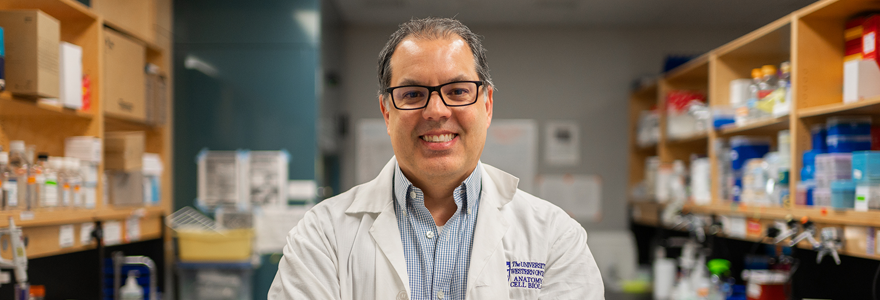
Shawn Whitehead, PhD, a professor in anatomy and cell biology and director of the Western Institute for Neuroscience (WIN), is leading work to transform disease detection with an advanced imaging platform that can map the brain in unprecedented detail.
“When we think about biomarkers of disease, we usually think of three main categories,” Whitehead said. “You might have an imaging biomarker, where you put someone in a scanner and see something wrong in the brain. Or you might have a fluid biomarker from a blood draw that shows signs of disease or risk for disease. Even a cognitive test for dementia can act as a biomarker.”
But these pieces rarely connect.
“What we don’t do very well is integrate all three. It’s like a jigsaw puzzle – the more information you have from different techniques, the stronger your diagnostic and predictive power becomes.”
Whitehead and collaborators were awarded $4.1 million from the Canada Foundation for Innovation (CFI), one of four projects at Western University to receive funding in the latest round of grants.
The initiative builds on the University's strength in imaging, positioning Western as a “global hub for precision neuroscience,” Whitehead said.
Our team is developing an advanced imaging platform to better understand brain diseases, infections and cancers. By combining different types of imaging technologies, including mass spectrometry imaging, we can create detailed maps of molecules within brain tissue.
Professor, Anatomy and Cell Biology; Director, Western Institute for Neuroscience
He uses the Google Maps analogy – instead of roads, this platform will navigate brain tissue.
“Instead of showing streets and buildings, it shows the precise location of molecules that might be involved in disease,” Whitehead said. “Fluid biomarkers might show you have molecules A, B and C and you’re at risk for certain diseases, but you don’t know where in the body these biomarkers are. That’s what the imaging diagnostic piece will bring.”
University Health Network and University of Ottawa will collaborate on the project, which is expected to train more than 80 young scientists.
The potential impact is huge.
“It’s really about creating a 360-degree view of brain disease,” Whitehead said. “Better biomarkers mean better clinical trials, more powerful diagnostics, opportunities for earlier diagnoses. Ultimately that will offer better treatment decisions for patients with strokes, Alzheimer’s or other diseases.”