

Search Website
Rare genetic mutations offer new clues to severe form of osteoarthritis
By Emily Leighton
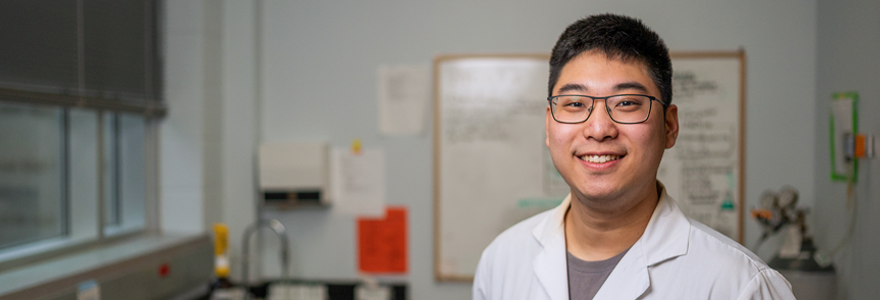
Research led by PhD candidate Justin Tang sheds light on the cellular mechanisms behind erosive osteoarthritis
By Emily Leighton
A rare and painful form of osteoarthritis can make some of the most ordinary parts of daily life – buttoning a shirt, opening a jar or gripping a pen – increasingly difficult.
Erosive osteoarthritis causes severe inflammation and accelerated damage to cartilage and bone, predominantly affecting the joints in the fingers.
New research led by PhD candidate Justin Tang, BMSc'22, has uncovered two rare genetic mutations that may offer clues to what is happening at the cellular level.
The study, published in PNAS, provides the first evidence linking mutations in two pannexin proteins, PANX1 and PANX3, to erosive osteoarthritis.
“Erosive osteoarthritis is severe; the pain has been described as feeling like lightning strikes that go deep in the cartilage and bone,” said Tang. “For many patients, the pain can be debilitating, affecting even simple activities. And because it’s a life-long condition with no cure, they may be living with that pain for years.”
The discovery began with a team at the University of Utah led by geneticist Michael J. Jurynec, PhD, who screened 40 families with a pattern of inherited erosive osteoarthritis of the hand. They identified two mutations, affecting PANX1 and PANX3, in separate families with high incidence of the disease.
That finding brought the research to Tang and his co-supervisors at Western’s Schulich School of Medicine & Dentistry – Silvia Penuela, PhD, professor in anatomy and cell biology, and the late Frank Beier, PhD, professor in physiology and pharmacology.
“Our collaborators identified changes in the patients’ genetic information, but we didn’t know how those changes affected the proteins,” said Tang. “With our expertise in pannexins, our goal was to bridge that gap and understand how the mutations might contribute to the development of erosive osteoarthritis.”
Pannexins are proteins that form channels on the surface of cells, allowing molecules involved in cell-to-cell communication to pass through. PANX1 and PANX3 are both found in bone and cartilage and play roles in processes such as cell growth, tissue development and inflammation.
Tang and the research team found that the two mutations disrupted those channels in opposite ways.
The PANX1 mutation made the channel overactive. When that activity continued over time, it also led to increased cell death.
Meanwhile, the PANX3 mutation made the channel less responsive to physical changes to the cell. In cell studies, the altered PANX3 protein was associated with reduced cell growth and increased cell death. Experiments in zebrafish embryos also showed increased cell death and changes in genes involved in bone function.
The PANX3 finding is particularly notable as it is the first naturally occurring mutation in the protein to be associated with human disease.
"Being able to find a genetic factor is a big step forward in understanding what can alter the disease and make someone more prone to developing it,” said Tang. “If we can better understand the disease and what contributes to it, eventually we may be able to tailor treatments for these patients.”
Getting to that answer also meant mastering a demanding technique called electrophysiology, which allowed the team to measure the electrical activity of individual pannexin channels.
It took Tang nearly a year to get the technique working. The challenge eventually took him to the University of Calgary, where collaborators helped him troubleshoot his experiments. There, he discovered that some of the results he had spent months questioning had been right all along.
"That was a big breakthrough,” he said. “Once I finished the electrophysiology, my skills got so much stronger and I started producing data much faster.”
Tang’s path to research began as an undergraduate student in Penuela’s lab, where he was first introduced to osteoarthritis research through co-author Brent Wakefield, PhD’23.
That work also introduced him to Beier, a leading osteoarthritis researcher who would become an important mentor. Beier was instrumental in bringing together the collaborators behind the PNAS study, including the Utah research team.
“The experience made me realize that sometimes science isn’t just about what you’re doing, but how you’re working with other people,” said Tang.
Even as Beier became seriously ill, Tang recalls the emails he sent offering encouragement and support.
“Without him, I wouldn’t be here,” said Tang. “It gave me the drive to do this to the best of my ability. I think that was his final gift to me.”
The PNAS publication marks a culmination of a research project years in the making, and an important step in his development as a scientist.
“This was the first project I helped build from the ground up,” said Tang. “It taught me not just how to do the science, but how to think creatively, learn from failure and keep moving forward.”