

Search Website
MD/PhD student receives Canadian Medical Hall of Fame Award
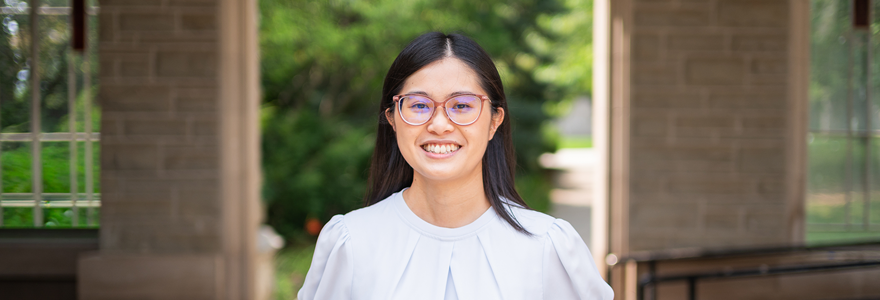
By Emily Leighton
Isis So is among this year’s recipients recognized for leadership, communication and a commitment to advancing medical knowledge
By Emily Leighton
At eight years old, a serious case of pneumonia gave Isis So an early glimpse into the medical profession. From then, she knew she wanted to be a doctor.
Figuring out what kind of doctor took a little longer, influenced by mentors along the way and a growing fascination with neuroscience.
Now an MD/PhD student at Schulich School of Medicine & Dentistry, So is pursuing a career that brings together patient care and scientific discovery.
This year, she is one of 15 students across Canada to receive the Canadian Medical Hall of Fame Award for Medical Students.
In this Q&A, she shares the experiences that shaped her and her ambitions as a future clinician-scientist.
Tell us about your background and early influences.
I was born and raised in Toronto, and my parents are immigrants from Hong Kong. They are both incredibly smart, talented and hardworking people, but didn’t have the same opportunities or support to pursue their own career ambitions.
My mother, in particular, pushed against some of the traditional gender roles and expectations I grew up around. She really advocated for me to have the educational opportunities she never had as a girl.
I’ve also been fortunate to have great teachers and mentors. My high school biology teacher was one of my first academic mentors, and we still keep in touch today. She was one of the first people I told about receiving this award.
After high school, I earned HBSc and MSc degrees at the University of Toronto. My master’s research was focused on traumatic brain injury.
When did you first realize medicine was the right path for you?
I knew pretty early. When I was eight years old, I had a serious bout of pneumonia and a long recovery. Throughout that process, I had exceptional doctors, nurses and health-care teams, and they inspired me to pursue medicine.
The research side came later. During my undergraduate degree, I worked in different areas of research. In my third and fourth years, I realized I was especially interested in clinical neuroimaging, neurological disorders and brain injury.
My research supervisors have been important influences. Seeing physician-scientists at work helped me understand what that career could look like and how research in the lab connects to clinical care and patient outcomes.
What is something people might be surprised to learn about you and your journey?
A big part of my journey has involved mentorship, particularly through U of T’s Community of Support program, which provides mentorship and resources for students who are underrepresented in medicine or face barriers to pursuing it.
I had access to free MCAT preparation and received mentorship through the application process. One of my mentors was herself an MD/PhD student.
Because I’ve benefited so much from mentorship, it’s something I really value and try to provide for others. At Western, I work with a similar student-run organization to support students interested in pursuing medicine.
What has challenged or changed your perspective since beginning your MD/PhD training?
When I started the MD/PhD program, I thought of the training journey as quite individual.
Over time, I’ve come to realize that individual capacity is only one component. There are many systems and supports needed for the long-term success of physician-scientists.
I’ve come to see health care in a similar way. Patient outcomes and the ability of providers to deliver care depend on the infrastructure and systems around them.
How do you stay grounded through the demands of training?
Having a life outside of medicine is so important.
I love spending quality time with my family and friends. My dog, Ethan, is also a big part of what keeps me grounded – he reminds me that there’s so much more to life than work.
It helps having friends going through the MD/PhD journey because they understand some of the challenges in a different way. And having mentors who have been through it is also extremely helpful. Sometimes it helps to simply have someone say, “Yes, I know what you’re going through.”
What advice would you give students interested in pursuing an MD/PhD?
Be resilient. It’s a long journey – the MD/PhD itself and the additional clinical and research training or fellowships.
I also encourage students to really know why they are pursuing medicine and research, and let that guide them on the days when nothing is working or everything feels stressful.
Looking ahead, what kind of impact do you hope to have as a clinician-scientist?
I definitely want to be a neurologist, working with patients, while also conducting research in neurodegeneration. There are a quite a few clinical trials happening in the field, and I hope we're moving closer to a cure.
I want to be part of that.