


Search Website
Life-saving surgery inspires gift to spinal implant research
By Kurt Kleiner
A Western grad’s donation advances research and graduate training in Dr. Victor Yang’s lab
By Kurt Kleiner
Back in 2018, Allison Chang, BA’96, BSW’23, began experiencing persistent headaches. They went on for about six weeks, growing so severe that she turned to acupuncture in hopes of finding relief.
Then things suddenly got worse.
“I had laid down for a nap, woke up, and it was like I was having a stroke,” she said. Her vision was blurry; she was dizzy and confused. She tried to dial 911, but kept entering 119. When a friend showed up – Chang had texted her, though didn’t remember doing it – her speech was slurred.
At Toronto’s Sunnybrook Hospital, doctors soon realized that she had developed a serious infection on the surface of her brain.
The neurosurgeon on call that night was Dr. Victor Yang. He performed a craniotomy, removing a portion of Chang’s skull to expose the brain and treat the infection.
“Thank goodness Dr. Yang was on call that night,” she said. “He’s a genius. His surgery no doubt saved my life.”
She began thinking about making a donation, but at the time, there was no way to direct her support specifically to Yang.
In 2022, Chang learned that Yang had relocated to Western University’s Schulich School of Medicine & Dentistry.
She was invited to tour his lab – and was immediately impressed.
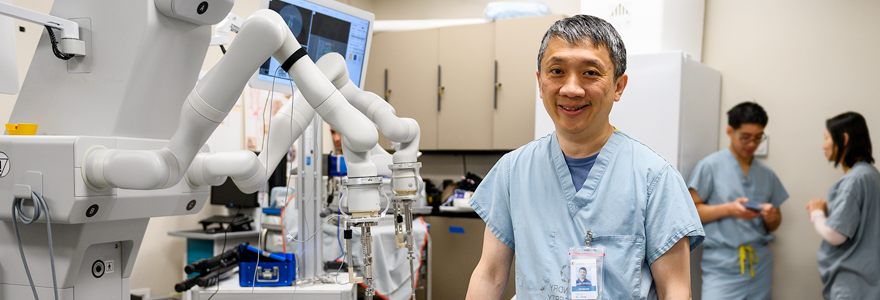
“It's phenomenal, the amount of research that he's putting into robotic surgery,” she said.
It was clear to her that the technology represented a major advance in treating people with brain and spinal injuries, and she was impressed by Yang’s dedication to research. As a PhD student at the University of Toronto, Chang was also struck by his commitment to mentoring graduate students.
Along with her husband, Jason Chang, BA’95, she arranged to make a donation of $60,000 over three years to directly support Yang’s research.
Advancing precision in neurosurgery
In addition to being a neurosurgeon, Yang is also an engineer. His work focuses on the use of robotics and neural implants, and he holds academic appointments in neurosurgery, medical imaging, orthopedic surgery, and medical biophysics.
As an engineer, Yang says that much of his research is about solving a “targeting problem.” The brain and spinal column are fragile, with a tremendous number of delicate nerves packed into a small area. Reaching and repairing those areas without causing damage presents a difficult technical challenge.
“A lot of the robotic work in neurosurgery is designed to deliver implants or drugs with extremely high accuracy, delivering material to the brain or the spinal cord or around the spinal column,” he explained.
The Changs’ donation will support a graduate student developing a next-generation spinal implant targeting system – technology that could offer researchers a far deeper understanding of how the spine functions and how it might be repaired. The work may lead to implants capable of ‘jumping’ electrical signals across damaged areas of the spinal cord, potentially treating damage caused by an injury or neurogenerative disease.
Yang says he is deeply grateful for the Changs’ support, “Philanthropy is incredibly important now,” he said. “It keeps the sparks alive. It allows us to keep dreaming big about the future and our neurological understanding of the spinal cord.”
For Chang, the decision to give was about more than her own personal experience.
“I'm grateful, but that wasn't the only deciding factor,” she said. “I really believe in the work that he's doing.”