


Search Website
“Junk DNA” holds clues to colorectal cancer, study finds

By London Health Sciences Centre Research Institute
Non-coding DNA can activate a protective immune response, pointing to new possibilities for cancer prevention and treatment
By London Health Sciences Centre Research Institute
For decades, large portions of the human genome were labelled “junk DNA". New research from Western University and London Health Sciences Centre Research Institute (LHSCRI) suggests these overlooked sequences may help protect the body from cancer.
The findings, published in Nature Communications, emerged from a closer look at inflammatory bowel disease (IBD), including ulcerative colitis and Crohn’s disease.
IBD is marked by chronic inflammation of the colon and carries a significantly increased risk of colorectal cancer. Over time, repeated immune-related injury damages the colon’s lining, creating conditions in which malignant changes are more likely to occur.
The research team, led by Dr. Samuel Asfaha, associate professor at Western’s Schulich School of Medicine & Dentistry, gastroenterologist at London Health Sciences Centre and scientist at LHSCRI, set out to understand how persistent inflammation reshapes DNA activity in the colon.
“We know that patients with IBD face a higher risk of colorectal cancer, but it has never been clear why some people develop cancer while others do not,” said Asfaha. “We wanted to understand what is happening at the molecular level in these chronically inflamed tissues and whether there are natural mechanisms in the body that might protect against tumour formation.”
The researchers discovered that inflammation appeared to awaken normally silent stretches of “junk DNA,” triggering a cellular response typically used to fight viral infections. This process, known as viral mimicry, causes cells to behave as though they are under attack, activating immune pathways that may suppress tumour formation.
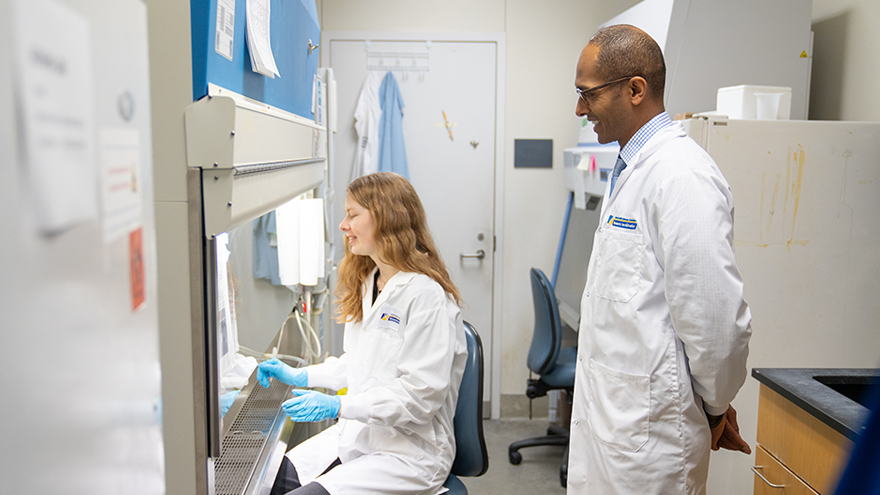
Postdoctoral associate Frederikke Larsen, PhD, works alongside Dr. Samuel Asfaha in the lab at London Health Sciences Centre Research Institute. (LHSCRI)
The team analyzed publicly available data from colonic biopsies of 41 healthy individuals, 22 patients with IBD and no signs of cancer, and seven patients with IBD and early signs of cancer. Individuals with IBD but no cancer showed evidence of this viral response, while those with early cancer did not, suggesting the mechanism may play a protective role.
To test whether this antiviral response was truly preventing tumour formation, the researchers disabled the cells’ ability to mount a virus-fighting response in preclinical models. Without it, the immune reaction did not occur and cancer developed.
Looking ahead, Asfaha and his team are now exploring ways to trigger this antiviral response to prevent cancer from developing.
“These findings are significant because they have implications for how cancer could be prevented in the future, especially for patients with IBD who have an increased risk of developing cancer,” said Asfaha. “It could also impact how we treat cancer in the future as we identify new ways to activate these viral responses.”
The study was funded by the Canadian Institutes of Health Research and the Cancer Research Society.