


Search Website
From billboards to the biology of HIV

By Evelyn Jones
PhD student Sarah Gowanlock is working to close gaps in HIV detection in Uganda, after modelling abroad helped shape her path
By Evelyn Jones
In a studio in Taiwan, a silkie chicken perched on Sarah Gowanlock’s shoulder. Minutes later, she would be photographed for a billboard towering over city streets.
But modelling was never the end goal.
Growing up on a farm near Goderich, Ontario, Gowanlock spent countless hours reading about the Black Death, an early fascination that sparked her interest in infectious diseases.
“It always fascinated me that something so small could be detrimental to society,” she said.
Today, Gowanlock is pursuing her PhD in microbiology and immunology at Western's Schulich School of Medicine & Dentistry. Her research focuses on quantifying and curing the HIV viral subtypes found in sub-Saharan Africa.
When she was accepted into Western’s undergraduate Bachelor of Sciences program, she knew she wanted to pursue infectious disease research but wasn’t sure where to begin. After struggling in her first two years, Gowanlock was offered a six-month modelling contract in Asia.
“I was like, you know what? Let’s do it,” she said. “When do we get these opportunities?”
After her contract, she returned to Western with a renewed sense of confidence. Living abroad pushed Gowanlock outside her comfort zone, helping her build independence that carried into her academic life.
Her grades improved drastically, and she began actively seeking out new opportunities. So, when Gowanlock heard about a seminar being presented by Jessica Prodger, PhD, she decided to attend.
While she didn’t know it at the time, this seemingly small decision set Gowanlock on her current path.
“Science can be intimidating since it’s a male-dominated field. But Jess, this powerful female scientist, stood in front of the room,” she recalled. “I thought to myself, she’s incredible. I want to work for her.”
Following the seminar, Prodger became Gowanlock’s mentor. As a PhD student in the Prodger Lab, she is investigating strategies to wake up and target the HIV viral reservoir for a cure.
But studying how HIV behaves in the body depends on being able to detect it accurately – something that becomes more challenging when the virus varies across regions.
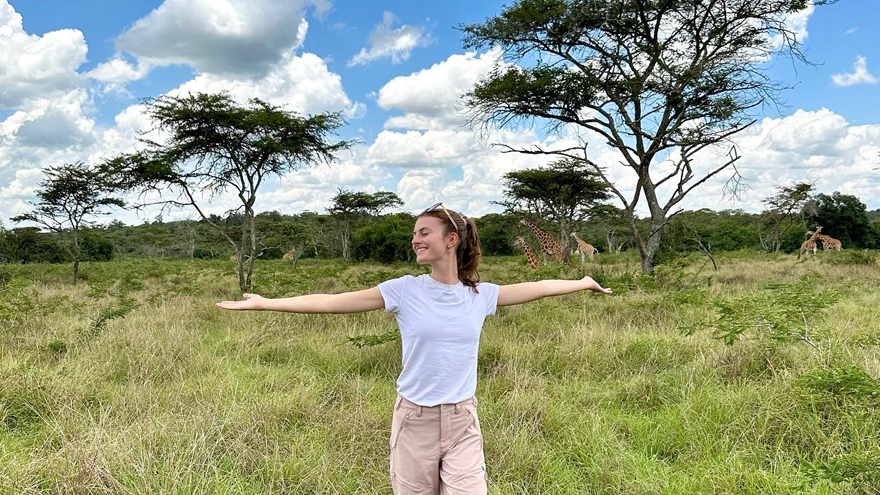
Gowanlock has completed three research placements in Uganda, studying HIV subtypes and adapting testing technology. (supplied)
With Prodger’s encouragement, Gowanlock travelled to Uganda to study HIV subtypes, gaining real-world experience to complement her lab work.
She has returned to the country three times, with her third visit funded through the Mitacs Globalink Research Award. Her work has also been supported by the Canada Graduate Research Scholarship from the Canadian Institutes of Health Research at both the master’s and doctoral level, as well as the Drs. Madge and Charles Macklin Fellowship for Teaching and Research in the Medical Sciences.
In sub-Saharan Africa, the most common subtypes of HIV differ from those typically found in North America. Because of genetic differences, standard lab tests used to measure HIV-infected cells often miss these subtypes.
“The tests fail because parts of the virus’ genetic code are different,” Gowanlock said. “The tools we use can’t properly recognize or bind to the virus.”
Working closely with the Ugandan Rakai Health Sciences Program, Gowanlock is helping adapt these tests. During her placements in Uganda, she has trained research technicians and worked directly with patient samples to refine the technology.
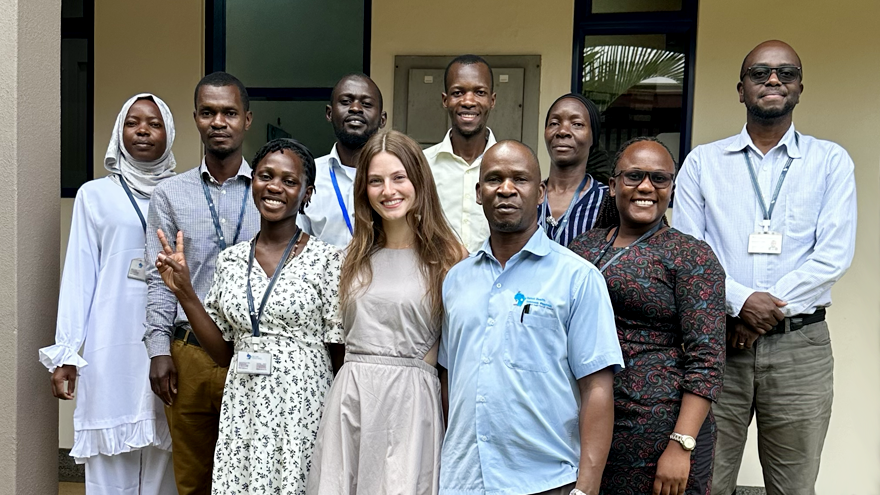
Gowanlock (centre) with Rakai Health Sciences Program staff and scientists, including Dr. Ronald Moses Galiwango (top right), laboratory director and Gowanlock’s local supervisor. (supplied)
But the challenge goes beyond detection.
“HIV is so difficult to cure because it hides inside immune cells, integrating into their DNA and becoming invisible when those cells go dormant,” she explained. “That makes it nearly impossible to identify and eliminate.”
In North America, HIV is often perceived as a manageable condition. Antiretroviral therapies allow people to live long, healthy lives, but they must be taken for life. In countries like Uganda, access to these life-saving treatments remains limited.
For Gowanlock, that’s what drives her work toward a cure.
“We don’t get to choose where we’re born. I’ve been incredibly fortunate to grow up in Canada with these opportunities, and I want to use that to help people who don’t have the same access.”
Gowanlock’s time in Uganda hasn’t just been about research – the small town of Kalisizo has become her second home.
“When I go back, the same kids are there and I stay in the same guest house,” she said with a smile. “It’s a very warm atmosphere. There’s lots of love and a huge sense of community, it’s incredible.”
Looking ahead, Gowanlock hopes to continue her work as a principal investigator, strengthening the connections she has built in Uganda and expanding access to global HIV research.
Moments of saying yes – to new experiences, new places, and new people – continue to shape her path.
“Say yes to the opportunities that come along,” she said. “That’s my advice to students – go to your classes and talk to your professors. It changed the course of my life.”