


Search Website
QUICK LINKS:
Capstone course helps students connect learning with real life
By Cam Buchan
A unique program that blends science with service has helped hundreds of future dentists, doctors and other health-care professionals step out of the classroom and into the community – forming deeper, more human connections with the people they hope to serve.
It’s all part of Community Engaged Learning and Research Skills, a capstone course for fourth-year students in the Honours Specialization in Interdisciplinary Medical Sciences at Schulich School of Medicine & Dentistry.
Those softer skills, like empathy, can be the difference between someone who’s competent and someone who truly connects to their patients.
Associate Professor, Anatomy and Cell Biology
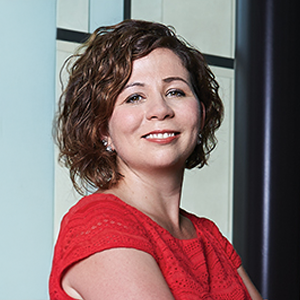
Created by associate professor Sarah McLean, PhD, the course places students face-to-face with some of London, Ont.’s most pressing health challenges – homelessness, substance use, food insecurity and aging among them – through partnerships with local organizations on the front lines.
By combining the social determinants of health with medical science, McLean is helping train a new generation of community-minded health-care leaders.
Since 2017, the program has connected 622 students with 56 community partners on more than 130 projects.
“Many students want to go into health-care professions,” said McLean. “That’s why I take a more holistic approach. Those softer skills, like empathy, can be the difference between someone who’s competent and someone who truly connects to their patients.”
The course isn’t just shifting perspective. For some students, its entirely reshaping their career paths.
It’s also making a difference for the community organizations the students serve, such as 519Pursuit, a grassroots initiative supporting individuals experiencing homelessness through friendship-based outreach.
“Working with the students has helped us accelerate our processes,” said co-founder Allison DeBlaire. “We don’t have a large leadership team, so their support has been extremely helpful.”
She added that these experiences give students crucial exposure to vulnerable populations. “It helps develop skills they’ll need in their careers.”
From isolation to inclusion
519Pursuit
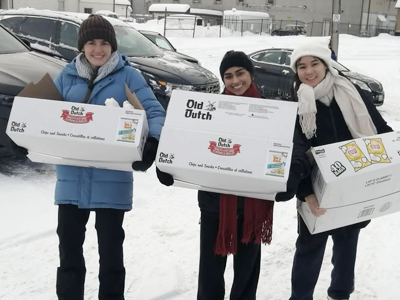
This year, a student team working with 519Pursuit created a mentorship program to help those ready to re-enter society develop life skills and routines.
“While resources exist for basic needs like food and shelter, social exclusion remains unaddressed despite its profound impact on health, education and housing outcomes,” said Jennifer Zhang, who worked on the project with classmates Cassia Donga, Ruoxin (Alice) Deng and Aamna Masud. “Our goal was to create spaces where people feel seen and valued, bridging the gap between isolation and inclusion.”
Donga says the experience highlighted how important advocacy will be in her role as a health-care professional.
“It’s essential to prioritize the unique needs of individuals experiencing homelessness, not just in terms of access to care, but in how we approach them with empathy, dignity and understanding,” she said.
Building cultural humility
Muslim Resource Centre for Social Support and Integration
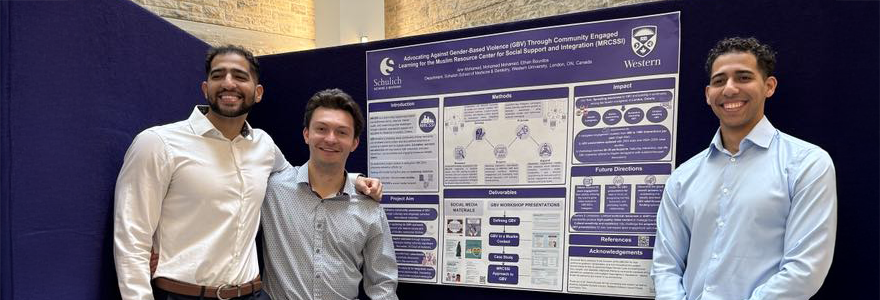
Amr Mohamed, Ethan Bourdos and Mohamed Mohamed brought a unique approach to their work with the Muslim Resource Centre for Social Support and Integration (MRCSSI). All three recently graduated from the combined BMSc/HBA program, taking Interdisciplinary Medical Sciences at Schulich Medicine & Dentistry and Honours Business Administration at Ivey Business School.
This year, the team partnered with MRCSSI to develop educational resources and community workshops on gender-based violence, ensuring content was trauma-informed, culturally relevant and accessible for Muslim newcomer families.
The project reaffirmed the team’s passion for working at the intersection of health care, community and equity, says Mohamed.
“We are committed to prioritizing cultural humility, health equity and active listening in our future work,” he said. “Our decisions have the power to either bridge or widen gaps in care, and we intend to use that responsibility to help build a more inclusive and socially accountable health-care system.”
Personal roots, community impact
ScleroCare
One of the course’s most personal projects is tied to McLean’s own journey. As a university student she watched her mother struggle with scleroderma – a rare, progressive autoimmune disease with no cure. The experience led her to research and, ultimately, to teaching.
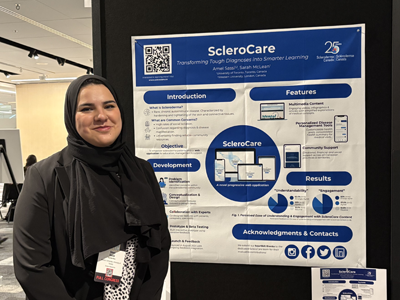
That personal connection carries on through ScleroCare, a mobile app first co-developed by alum Amel Sassi, BMSc’22, in an earlier iteration of the course.
Created in partnership with the Scleroderma Society of Canada, the app offers information and community support to patients who often feel isolated by the condition.
The baton was passed to this year’s team – Tori Chen, Richa Bhandari, Sally Gaherty and Rajen Jned – who worked on further enhancements to the app, alongside Sassi as the community partner. They enhanced the app with digital resources on clinical trials, medication options and financial aid.
“Local organizations like ScleroCare are the heart and soul of our communities,” said Bhandari. “Working with them allows us to bridge the gap between complex medical knowledge and those who need it most.”