


Search Website
QUICK LINKS:
Trailblazing surgeon and researcher honoured for career impact
By Emily Mackey, St. Joseph’s Health Care London
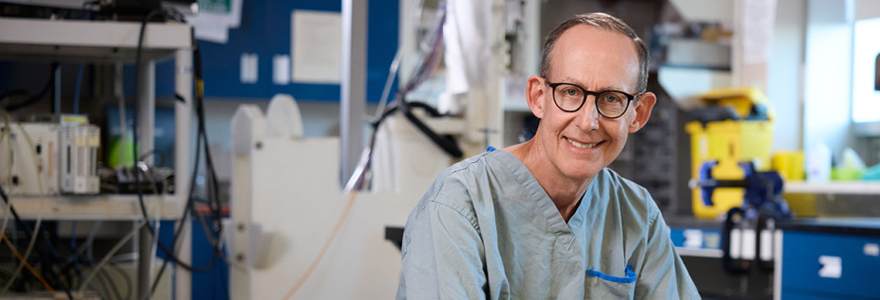
You likely wouldn’t know Dr. Graham King is one of Canada’s most accomplished orthopaedic surgeons unless you heard it first from a patient, colleague or international specialist.
Quietly modest, he isn’t apt to tell you the elbow implant he and his team developed is now one of the most widely used in the world.
So, it’s not surprising he’d also be among the last to tell you the Canadian Orthopaedic Association (COA) recently recognized him with a Lifetime Achievement Award for his considerable contributions to teaching, research and clinical care.
“I’m very proud of the honour, of course, but you don’t get an award like this alone. I would not have received this without my team,” he said.
Since 1992, King has been working alongside his colleagues in the Roth | McFarlane Hand and Upper Limb Centre (HULC) at St. Joseph’s Health Care London and the Department of Surgery at Schulich Medicine & Dentistry to fill a gap in understanding elbow disorders and improving patient outcomes.
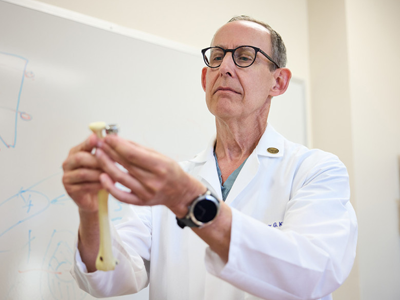
In the HULC bioengineering lab, he works with Jim Johnson, PhD, professor in engineering and orthopaedic surgery, and a team of researchers to ask clinically relevant questions and develop new solutions.
Those solutions are then studied in patients in the clinical research lab alongside Joy MacDermid, PhD, professor and the lab’s co-director, where King’s team can report on the outcomes and effectiveness of the surgical interventions.
These interventions, along with improved physiotherapy practices and the creation of joint replacement implants, have been revolutionary in treating elbow disorders. Now, patients are reporting excellent outcomes for, on average, 17 years post-surgery.
The radial head replacement – an elbow replacement made of cobalt chrome created in the HULC bioengineering lab at Lawson Research Institute of St. Joseph’s – is one of the best-selling radial head implants in the world.
“It’s a good feeling, that all our efforts to develop new technologies for elbow problems have improved patient care. It’s a very rewarding part of my career, to see all the advances we’ve made,” said King.
King has been an international resource for training and education throughout his career. He served on the executive board of the Canadian Orthopaedic Research Society, a subspeciality of COA, and was its president in 2002. King has also represented Canada as a travelling fellow, visiting health-care organizations across North America, England and South Africa to teach surgeons and exchange knowledge. He has routinely taught instructional courses at the COA for more than 30 years.
The COA Lifetime Achievement Award recognizes sustained and consistent contributions to the COA and the profession, the highest standard of patient care, and a significant impact nationally and internationally.
The themes of teamwork and leadership are central for King. Despite the many successes in his career, he is most proud of his trainees – the residents, fellows and research trainees who have worked with him. “I’m very proud of the mentorship I’ve been able to provide,” he said.
In a career that has spanned more than 30 years, the number of patients King has helped is vast. Whether through direct patient care or indirectly through advancements in surgical techniques and implants, he has had a profound impact on those with upper limb concerns.
“Patient care is always number one,” he said. “The most rewarding part of my job is seeing patients being able to get back to work, to their hobbies, their sports – that's where I get the most satisfaction.”