


Search Website
QUICK LINKS:
The human touch, reimagined with AI
By Emily Leighton
Artificial intelligence (AI) is already reshaping health care, promising to ease administrative burdens, reduce errors and accelerate routine procedures. As it expands into exam rooms and dental clinics, some clinicians are turning to AI for something less obvious: to safeguard the human side of care.
Meet two alumni who are at the forefront of this transformation.
Smarter notes, better care
When Dr. Adeel Sheikh, BMSc’19, MD’24, started his family medicine residency at St. Michael’s Hospital in Toronto, he quickly ran up against familiar limits. Patient encounters came back-to-back, with only small pockets of time for feedback from supervisors.
Looking for extra support, Sheikh cycled through existing AI tools, but none quite fit. Most produced notes, but little else.
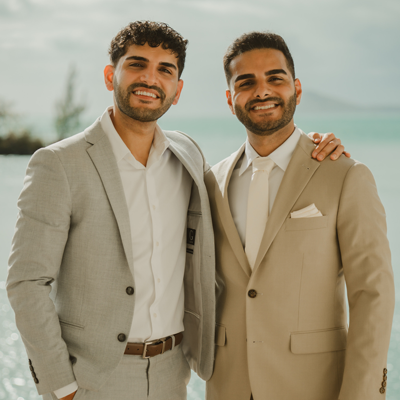
The experience sparked Vero Scribe, an AI tool Sheikh co-founded with his brother, a software engineer. Launched in late 2024, it has already grown to 3,000+ users across North America and formed partnerships with hospitals like St. Michael’s.
“We wanted to create a software that anyone could jump on and learn how to use in under 10 minutes,” said Sheikh.
At first glance, Vero Scribe looks similar to other digital scribes on the market, recording encounters and drafting clinical notes. But its distinguishing feature is clinician feedback. Vero Scribe analyzes notes against the latest regional guidelines – flagging, for instance, when local resistance patterns suggest using a particular antibiotic – and hands that insight back to the health-care provider.
Vero Scribe also generates a written summary of the encounter for patients, which can be translated into more than 50 languages.
"It’s the only tool on the market that gives direct, specialty-specific feedback based on the latest clinical guidelines,” said Sheikh. “It’s about giving doctors more time to focus on patients rather than on the computer screen, while ensuring care stays rooted in evidence-based guidelines.”
Going for speed and precision
On the dental side, Dr. Chris Ciriello, BMSc’02, DDS’08, is asking a daring question: what if AI could perform the procedure itself? His Boston-based company, Perceptive, recently completed the world’s first fully automated dental surgery on a human.
The system combines 3D imaging with a robotic arm capable of carrying out restorative procedures, beginning with crown placements. A task that normally requires two lengthy visits can now be done in about 15 minutes. “We’re setting a new standard of care,” Ciriello said, describing the breakthrough as a way to make dentistry faster, safer and more widely accessible.
Early studies show Perceptive’s imaging has the capability to detect cavities with more than 90 percent accuracy, far outperforming traditional X-rays. The company has raised $30 million in venture funding and forged partnerships with the Harvard School of Dental Medicine and the Forsyth Institute.
Automation on this scale unnerves some, given how tactile and personal dentistry can be. But Ciriello sees it differently: if robots handle the mechanical precision, dentists can focus on explaining, reassuring, and building long-term relationships with patients.
"Dentistry will always be personal,” he said. “What AI offers is the chance to put that personal connection back at the centre of care.”
Enhancing, not replacing care
Neither Sheikh nor Ciriello believes AI will replace the human role in care. Sheikh underscores that strong physician-patient relationships are at the heart of medicine. Ciriello frames robotics as a democratizing force, meant to broaden access rather than erase the dentist’s presence.
“AI shouldn't replace the patient-provider relationship,” said Sheikh. “But if it helps us listen more closely and improve care, then it’s worth embracing."