


Search Website
Honouring Braxton through support for brain research
By Kurt Kleiner
In the wake of their son Braxton’s short life, Spencer and Shelby Brown found a way to honour him while supporting the next generation of brain researchers
By Kurt Kleiner
Spencer and Shelby Brown’s story begins on Concrete Beach during their undergraduate years at Western University – though their memories of that first moment don’t entirely match.
“I remember meeting her, but she doesn’t remember meeting me,” Spencer, BESc’13, explained.
A few years later, while living in Toronto, they were (re)introduced by a mutual friend. They married and later moved to St. Catharines, Ontario, where they had a little boy, Stratton, now three years old.
“He’s opinionated, independent and just a bundle of joy, that guy,” Shelby, BA’13, said.
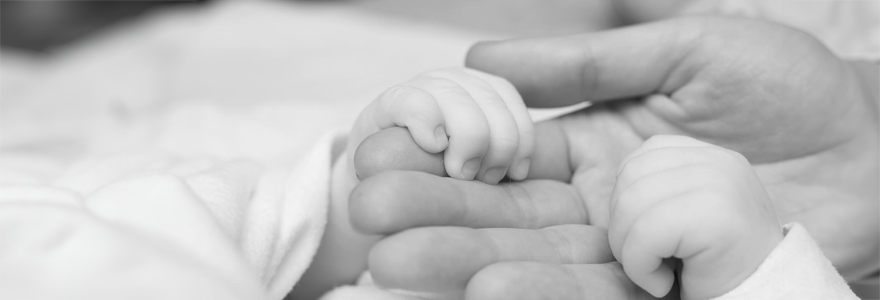
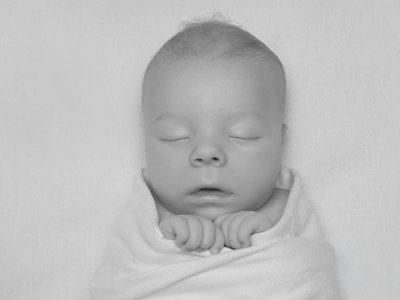
In June of 2024, Shelby went to the hospital to deliver their second boy, Braxton. Everything was fine when she walked in. But there were serious, unexpected complications. During the difficult delivery Braxton suffered a lack of oxygen that caused a catastrophic brain injury.
At first, Shelby and Spencer expected that their son would get better with treatment. But they gradually realized that the neurological damage was too severe and could not be reversed.
“He never opened his eyes, he never cried,” Spencer said. “And you know, through that time period, we were like, they'll be able to fix him. And as we learned more, we realized you can't fix the brain.”
Braxton died 44 days after he was born.
Even as Shelby and Spencer grieved, they began to think about a way that they could memorialize Braxton and at the same time, contribute to research to help children in the future.
Their friend Glain Roberts-McCabe suggested making a research donation, and Shelby and Spencer spent months exploring how to go about it.
“In our unwanted, unexpected crash course in neurology last summer, we were just stunned by how much is still not known about the brain,” Shelby said.
They met with clinician-scientists at Schulich Medicine & Dentistry, including Dr. Craig Campbell, a pediatric neurologist and chair of the Department of Paediatrics, and Dr. Rishi Ganesan, a pediatric neurocritical care physician, to learn more about the research underway in pediatric neurology.
Ultimately, those conversations led them to establish the Braxton Stokes Brown Award in Paediatric Neuroscience. The permanent endowment, raised through contributions from family and friends, will fund an annual award of $1,000 to a resident or graduate student working to understand the brain and how to repair it. Their hope is to continue to increase and grow the award over time.
“It may be modest compared to the cost of education and research, but we hope its impact will extend beyond the financial contribution,” Spencer said.
Campbell agrees that the award is important not just for the research it will fund, but also because of the story it represents.
“Recipients know how important the research is scientifically and clinically. But to be able to connect it to a family’s personal experience makes it that much more meaningful, and drives you to do more,” he said.
Campbell says that as a young researcher he received a small gift from a family for work in muscular dystrophy, and it motivated his entire career.
“It's not easy to go through what they've gone through. To use that experience to go and help others, that's a special kind of family and special kind of generosity,” Campbell said. “It’s what inspires us as scientists and clinical investigators. We're very, very grateful to them.”
For Spencer and Shelby, the award holds the hope of helping other parents and children in the future. And it’s a way to keep Braxton’s memory alive.
“We talk about him every day,” Shelby says. “We don't want him to be forgotten.”