


Search Website
QUICK LINKS:
Clinical trial could help people with kidney failure live longer

Marzena McDonald, London Health Sciences Centre Research Institute
Researchers at Schulich School of Medicine & Dentistry and London Health Sciences Centre Research Institute (LHSCRI) have launched a clinical trial to test a next-generation dialysis filter that could transform care for people living with kidney failure across Canada.
The Elisio HX™, developed by Nipro, is designed to clear a wider range of toxins from the blood than standard filters – a breakthrough scientists believe could help patients live longer, healthier lives.
Dialysis is an essential, life-sustaining treatment for millions of people living with kidney failure. It uses a special filter to do the work of the kidney by removing waste, salt, and fluid from the blood. However, dialysis can lead to quality-of-life concerns. Most patients require it at least three days a week and each treatment lasts several hours. A dialysis filter does not work as effectively as a real kidney, which also limits life expectancy.
“While kidney transplants remain the best option for survival, they can involve long waits and many patients are not eligible,” said Dr. Pavel Roshanov, assistant professor, scientist at LHSCRI and nephrologist at London Health Sciences Centre (LHSC). “It's therefore critical that we improve dialysis to enhance patient outcomes, including quality of life.”
The five-year multi-centre randomized trial, called DIALEX, will include up to 4,800 patients across more than 100 dialysis units in Canada. This includes dialysis units at LHSC and its satellite locations in Chatham, Goderich, Hanover, Owen Sound, Sarnia, Stratford, Tillsonburg, and Woodstock, Ontario. Participating patients are randomized to receive dialysis with the standard filter used in most hospitals or a newer type of filter. Heart problems, survival, and symptoms associated with dialysis will be compared to determine if dialysis with the new filter leads to better health outcomes and quality of life.
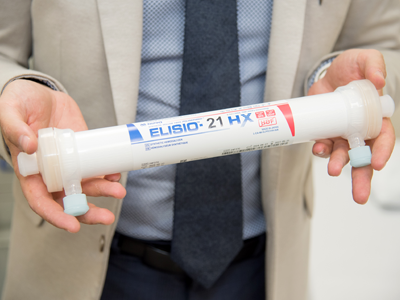
“In this study, we will learn at least two important things,” said Roshanov. “The first is whether eliminating more toxins through these new types of dialysis filters improves survival. The second is whether this kind of treatment reduces hospitalizations for various reasons, like heart attacks, strokes, or infections, and if patients feel better overall.”
Unlike many clinical trials which rely on care being provided in a research-intensive hospital, this study aims to include community hospitals across the country. This will allow patients living in rural areas the opportunity to participate in the trial without needing to travel.
“This study is about putting patients first,” said Roshanov. “By expanding access to participation in this trial, we not only ensure our findings are representative of as many patients as possible, we can also offer an opportunity to patients to access treatments they otherwise wouldn’t be able to.”
Funding for the trial was provided by the Canadian Institutes for Health Research and the School's Health Data Research Network Canada Pragmatic Trials Training Program.