

Roni Kraut: From Accounting to Long-term Care in Canada
A Pragmatic Trial that Challenges Polypharmacy in Long-term Care
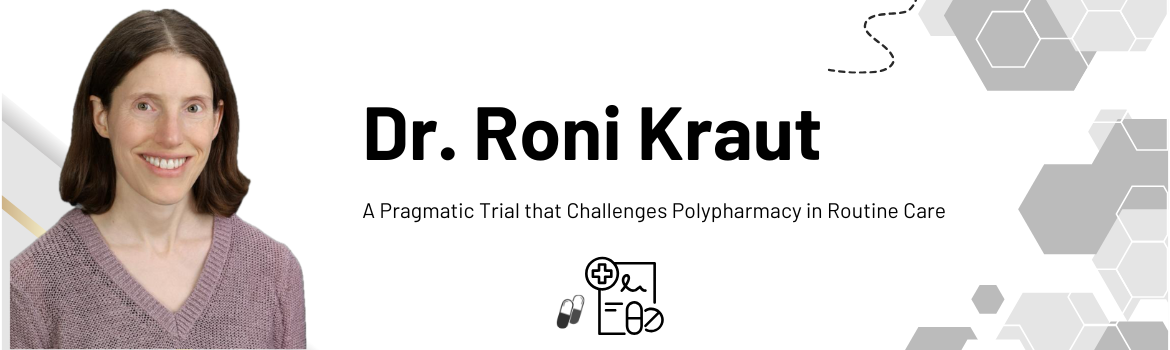
By: Houda Houbeish
While working as a family physician in long-term care, Dr. Roni Kraut often encountered the same problem: residents arriving with lengthy medication lists. To improve health care and reduce inefficiencies, she has long believed in the value of deprescribing low-risk medications that have no proven benefit. Today, as an enrolled learner in the Health Data Research Network Canada (HDRN Canada) Pragmatic Trials Training Program under the Future Trial Leaders stream, Dr. Kraut is developing a pragmatic trial protocol to test this intervention in a real-world setting.
“I am finally working on the trial that I always wanted to develop and implement. Thanks to the program, I am now developing this trial’s protocol,” Dr. Kraut said.
From Accounting to Medicine at the Age of 30
Dr. Kraut started her professional life as an accountant. Despite building a successful career in accounting and receiving accreditation, she decided to shift gears into medicine when she was 26. She enrolled in medical school at the age of 30.
Today, Dr. Kraut is a family physician affiliated with the University of Alberta, a career she built while also building her own small family, as she had two children while in medical school. She dedicates 50% of her time to research and the remaining 50% to long-term care and family medicine practice.
Polypharmacy as a Challenge in Long-term Care
Polypharmacy refers to taking multiple medications simultaneously, usually five or more. In the long-term care population, polypharmacy is an ongoing challenge; it is linked with poorer function, reduced quality of life, higher healthcare costs, and environmental harm.
“As part of my work as a long-term care physician, I often see new patients admitted to health care facilities with long pages of medications. We also see nurses very busy dispensing medication. For instance, if a patient is on the typical number of medications in long-term care, around 10 medications, this requires dispensing medication multiple times a day. Reducing the number of medications by 4 to 5 medications means that the nurse will have time to do many things that are more impactful for the resident’s care than dispensing low-value medications.”
Dr. Kraut’s goal is not limited to optimizing nursing time. She also explains that the increasing number of medications given to a patient leaves more room for medical interactions, adverse events, and medical errors. More importantly, she explains, the benefit of many of these medications is minimal, as the benefit-risk balance changes as people progress in frailty.
“When someone is at the age of 40 or 50, they might be prescribed a blood pressure medication. However, the same medication will not be as efficient for them when they are 90 years old, and it might even be harmful. Therefore, medications need to be re-evaluated as the person becomes frail. With frailty, a different approach needs to be taken.”
Taking off Lower-risk Medications
To address the challenge of polypharmacy, Dr. Kraut is working on a pragmatic trial that tests a new approach, focusing on lower-risk medications that are efficient to remove. According to her, many lower-risk medication have little benefit and can easily be removed from patients' medication lists without needing tapers or consultation. Meanwhile, the current practice is to typically focus on reducing high-risk medications.
“High-risk medications, like anti psychotics, are so hard to deprescribe. You cannot simply say you want to take them off and then do so. You need to talk to the family and staff, observe the resident’s behaviour, and then revisit and monitor any changes. So, it takes a long time and a long process, and is difficult for LTC facilities to integrate into routine care. However, lower-risk medications are much easier targets; they are often quick to remove, and while they are lower-risk, they are not no-risk, and there is still value to stopping them.”
Dr. Kraut believes that enrolling in the HDRN Canada pragmatic trials training program gave her the space to develop her observation into a research protocol for a pragmatic trial: “When I first enrolled in the program, the trial that I was planning to do was very different. But through the program, I was able to shift to what I feel is a more useful and pragmatic trial.”
** The HDRN Canada pragmatic trials training program is coordinated and hosted by the Schulich School of Medicine & Dentistry and is an initiative by Health Data Research Network (HDRN) Canada. It has been funded with $3.48 million from the Canadian Institutes of Health Research (CIHR). Read more.
Watch this video for a brief overview of Dr. Kraut's story


